

Consumer Insights
Uncover trends and behaviors shaping consumer choices today
Procurement Insights
Optimize your sourcing strategy with key market data
Industry Stats
Stay ahead with the latest trends and market analysis.
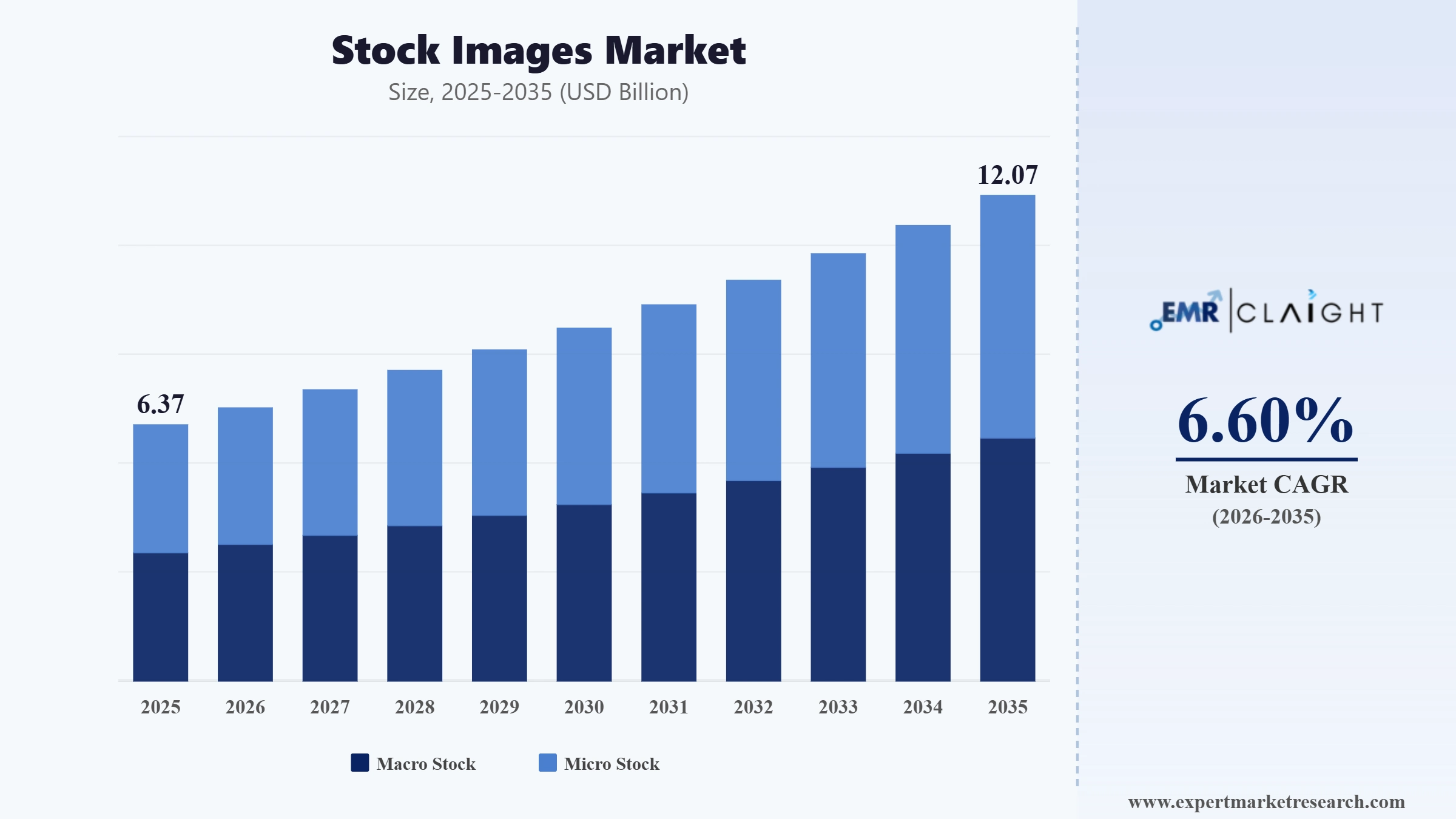
The global stock images market was valued at USD 6.37 Billion in 2025. The market is expected to grow at a CAGR of 6.60% during the forecast period of 2026-2035 to reach a value of USD 12.07 Billion by 2035. The market is expanding steadily, driven by the rapid growth of digital content creation, online marketing, and media consumption.
As businesses increasingly rely on visual storytelling to connect with audiences, demand for high-quality, rights-cleared stock photos and videos has surged across sectors. With the rise of digital transformation, small businesses, content creators, and global enterprises are adopting subscription-based stock image platforms to access professional visual assets. In September 2025, iStock introduced a subscription model that allows unlimited downloads & modifications plus access to generative AI-powered image creation. Platforms like Shutterstock, Adobe Stock, and Getty Images have diversified their offerings to include footage, vector illustrations, AI-generated visuals, and editorial content, expanding use cases across geographies.
The growth of the stock images market is supported by expanding digital marketing budgets, increased content output by businesses, and the rising need for cost-efficient visual assets. In 2024, Adobe Stock reported a 17% increase in image downloads across North America and Europe, citing higher adoption by freelancers, agencies, and SMEs. Additionally, the growth of e-learning and remote work has boosted the use of stock visuals in presentations, training materials, and virtual classrooms. Investments in AI-generated image platforms and improved API integrations with design software have also made it easier for users to source and customize stock assets.
Content localization, the creator economy, and the increasing popularity of AI-driven design tools are further shaping demand patterns. Stock images are now critical for social media marketing, website development, e-learning, and product packaging. As copyright regulations tighten, users are shifting from free, open-source content to licensed alternatives to mitigate legal risks. With visual content becoming a strategic necessity, the global stock images market is well-positioned for sustainable growth.
Read more about this report - REQUEST FREE SAMPLE COPY IN PDF
Digital Marketing and Social Media Content Demand
The insatiable demand for visual content across digital marketing channels is the primary structural driver of the stock images market. Social media platforms including Instagram, Facebook, LinkedIn, TikTok, Pinterest, and X (formerly Twitter) require brands, publishers, and individual creators to produce visual content at a frequency and volume that makes original photography impractical for the majority of use cases. The social media application segment reflects the continuous expansion of social media advertising spend globally and the increasing importance of high-quality visual content in driving engagement and conversion rates.
E-commerce has become one of the fastest-growing demand sources for stock imagery. Online retailers require product-in-context lifestyle photography, banner images for seasonal promotions, thumbnail visuals for category pages, and advertising creative across paid search and social channels. The economics of producing this volume of custom photography are prohibitive for all but the largest brands, making stock imagery a cost-effective and operationally efficient alternative for the vast majority of e-commerce operators.
Subscription Model Adoption and Enterprise Licensing
The shift from per-image purchase pricing to subscription-based licensing is one of the most significant structural changes in the stock images market. Subscription models offering unlimited or high-volume downloads for a fixed monthly fee have dramatically reduced the friction associated with accessing stock imagery, expanding the active buyer base and increasing the frequency with which existing subscribers consume content. Large enterprises, the largest end-user segment in the market, have migrated toward enterprise licensing agreements that provide all employees with access to a platform's full library under a single contract, simplifying procurement and ensuring brand-consistent imagery across departments.
In September 2025, iStock launched a subscription model offering unlimited downloads and modifications combined with access to AI-powered image creation tools, reflecting the industry's move toward bundling traditional stock imagery with generative AI capabilities within a single subscription tier. This bundling strategy creates a more comprehensive value proposition that is more difficult for free platforms to replicate.
AI Integration: Tools, Training Data, and New Workflows
Artificial intelligence is transforming every dimension of the stock images market. At the platform level, AI powers improved search and discovery through visual recognition, semantic search, and automatic content tagging, enabling buyers to find exactly the image they need from libraries of hundreds of millions of assets with far greater speed and precision than keyword-only search allows. At the creation level, AI image generation tools are enabling platforms to expand their effective content libraries dramatically and to offer buyers the ability to generate custom imagery for specific use cases directly within the platform workflow.
In August 2025, Adobe Stock unveiled a comprehensive suite of AI-powered creative tools integrated directly into its stock platform, enabling users to generate, refine, and license images within a single workflow without switching between applications. This integration with Adobe Creative Cloud, which has approximately 35 million subscribers, creates a distribution advantage that standalone stock platforms cannot replicate.
The monetization of historical image archives as AI training data has emerged as a significant new revenue stream. Shutterstock's USD 104 million in AI licensing revenue in 2024 demonstrated that established platforms with large, well-curated image libraries have a commercially valuable asset in the AI training data market, providing revenue that partially offsets the downward pressure on traditional subscription pricing from AI image generators.
Creator Economy and Democratization of Visual Content
The rapid expansion of the global creator economy individual content creators who produce video, written, and visual content for social media, blogs, newsletters, and online courses is generating substantial demand for stock imagery at accessible price points. Creators require professional-quality imagery for thumbnail creation, social posts, website design, and advertising creative, but typically lack the budget for commissioned photography. Stock image subscriptions at consumer price tiers serve this segment effectively, and the continued growth of platforms like YouTube, Instagram, TikTok, and Substack is directly correlated with growing demand for the stock imagery that creators use in their content.
Globally, the creator economy is estimated to encompass more than 50 million active content creators, with the number growing rapidly as platforms lower the barriers to publishing and monetizing content. This segment's demand for stock imagery is particularly price-sensitive and quality-flexible, making it a core target market for subscription offerings at introductory and consumer price tiers.
Diversity, Authenticity, and Inclusive Visual Representation
A significant content-level trend reshaping the stock images market is the growing demand from brands and marketers for imagery that reflects genuine diversity, authentic representation, and real-world scenarios rather than the sterile, posed, demographically narrow photography that characterized early stock image libraries. Over 35% of new uploads on major stock platforms emphasize diversity and authenticity, reflecting both supplier response to buyer demand and platform policies encouraging more representative content.
This demand for authentic imagery extends to the portrayal of disability, age diversity, LGBTQ+ identities, diverse body types, and the representation of cultures and communities that were historically underrepresented in stock photography archives. Brands that have shifted their advertising toward more inclusive visual representation have documented measurable improvements in consumer sentiment and purchase intent, creating a commercial case for the demand for diverse stock imagery that reinforces organic cultural pressure.
Getty Images and Shutterstock announced a merger valued at USD 3.7 billion, creating a premier visual content company. The combined entity, named Getty Images Holdings, Inc., aims to meet the evolving needs of creative, media, and advertising industries through combined investment in content creation, event coverage, and product and technology innovation.
Shutterstock, Inc. launched its generative 3D API, enabling enterprises to quickly create realistic 3D models using AI. Built on NVIDIA Edify’s architecture, the API was trained solely on Shutterstock’s ethically sourced content, including over 500,000 3D models and 650 million images, ensuring fast, ethical, and high-quality 3D asset creation for businesses worldwide.
VectorStock.com launched a new collection of animal-themed vector art images designed specifically for print-on-demand businesses. This diverse range of high-quality, scalable illustrations helps designers and entrepreneurs easily create merchandise, branding, and decor featuring popular animal designs.
Adobe Stock expanded its AI tool, Firefly, to a global audience by adding multilingual prompt support, allowing creators from non-English speaking regions to generate images more easily using their native languages. The update boosts accessibility, encourages diverse creative expression, and broadens Adobe Stock’s reach in international markets.
The growth of online advertising, influencer marketing, and online shops is fueling the demand for stock images. Shopify integrated Unsplash APIs to merchant dashboards in July 2025 to enable real-time visual improvements to product listings. Fine-quality images improve product visibility and user experience, particularly on mobile-first devices. Stock sites now provide curated sets specifically for holiday promotions, seasonal fashion, and viral social formats, further integrating visual content into marketing.
Artificial intelligence (AI) is revolutionizing how users find, create, and customize stock images. Shutterstock introduced generative AI capabilities in its creative platform in January 2023, allowing users to create images directly from text prompts instantly. Adobe Stock's Firefly AI also enables creatives to edit and re-mix pictures using generative design capabilities. These technologies minimize reliance on conventional photoshoots, accelerate content creation, and enhance relevance.
The stock images market share is increasing with increased awareness of the necessity of real and diverse visual representation in media. Getty Images, in association with Dove and Girlgaze, introduced the #ShowUs collection of women and non-binary individuals across the world in March 2022. Stock libraries are localizing content more to depict diverse cultures, occupations, body types, and disabilities. The development towards inclusive imagery is redefining content procurement strategies worldwide.
With stricter copyright laws and growing awareness about image licensing, users are migrating from free-use content to professionally licensed platforms. Companies now seek indemnified image sources to avoid copyright infringement lawsuits. In January 2023, Getty Images filed legal action against unauthorized AI-based use of its licensed content, reinforcing the need for clear licensing protocols. Enterprise clients prefer platforms that offer model and property releases, ensuring safe usage in the stock images industry.
The expanding creator economy, with influencers, podcasters, and YouTubers generating content at scale, is fueling demand for accessible and royalty-free visuals. Subscription-based platforms like Canva and Envato have partnered with image libraries to offer bundled creative solutions. For instance, Canva Pro subscriptions surged in Latin America and Southeast Asia, highlighting rising visual content needs from small creators. Freelancers, bloggers, and small businesses prefer cost-effective and versatile image packages, driving demand for microstock platforms with flexible pricing models.
Generative AI Disruption and Free Image Generation
Generative AI represents the most significant structural threat the stock images industry has faced. AI image generation tools including Midjourney, DALL-E, Stable Diffusion, and Adobe Firefly enable users to create photorealistic, custom images from text prompts in seconds, at marginal cost close to zero. Adobe's Firefly image generator alone created approximately 3 billion images within months of its launch, a volume that exceeds the total archives of many traditional stock image libraries. As these tools improve in quality and accessibility, they increasingly serve use cases previously met by stock image subscriptions, particularly for concept imagery, editorial illustrations, and product-in-context lifestyle visuals where exact authenticity of subjects is not required.
The combined impact of AI image generation and the growth of free platforms including Unsplash, Pexels, and Pixabay, which now also offer AI-generated image content alongside their traditional contributor libraries, has introduced significant competitive pressure on the paid stock image market's pricing power and subscriber retention. Both Pexels and Unsplash have added AI-generated imagery to their platforms, blurring the traditional distinction between free and paid stock image services.
Copyright, Legal Liability, and AI Training Data Disputes
The intersection of stock imagery and generative AI has generated substantial legal complexity. Class action lawsuits were filed by photographers against major stock image platforms in Q2 and Q3 of 2025, with cases centering on whether platforms had the right to license photographer-contributed imagery to AI model developers as training data. These cases were still pending as of early 2026. In the United States, purely AI-generated images without meaningful human creative input may not be protectable under copyright law, creating uncertainty about the legal status of AI-generated stock imagery and the scope of the commercial license granted by platforms distributing such content.
Most stock image platforms now explicitly prohibit the use of licensed images to train artificial intelligence systems, a term that was not typically present in licensing agreements before 2023 and that reflects the rapid evolution of both the technology and its legal implications. Brands and enterprises purchasing stock image subscriptions must ensure that their usage of licensed imagery does not inadvertently create AI training data liability.
Free Platform Competition and Price Compression
The availability of large libraries of high-quality, commercially licensed images on completely free platforms has eroded the addressable market for paid stock imagery, particularly at the low-price-point end of the market. Platforms like Unsplash, Pexels, and Pixabay have attracted millions of contributing photographers who upload content in exchange for portfolio exposure and attribution, creating free libraries of millions of professional-quality images that serve many of the needs previously met by entry-level paid subscriptions.
While free platforms carry limitations around exclusivity, indemnification, and model release documentation that are significant for enterprise buyers in regulated or high-liability marketing contexts, they have effectively claimed the low-end of the market and are making steady inroads into the mid-market through improved search, editorial quality, and now AI image integration.
Market Consolidation and Competitive Dynamics
The January 2025 announcement of a USD 3.7 billion agreement for Getty Images to acquire Shutterstock, creating what would be the world's largest licensed visual content business, signals the intensity of competitive pressure in the market. The deal was driven partly by a desire to consolidate overlapping operational costs in a market where AI-driven commoditization is compressing margins, and partly by a strategic intent to present a more powerful negotiating position when licensing image archives to AI training data developers. The combined entity would control an archive of more than 600 million images, videos, and music tracks, representing an unmatched commercial visual content library.
The merger's outcome will have significant implications for the competitive dynamics of the remaining market: a combined Getty-Shutterstock entity at this scale would be a formidable competitor for Adobe Stock and the remaining independent platforms, potentially accelerating market consolidation further.
The Expert Market Research report titled “Global Stock Images Market Report and Forecast 2026-2035” offers a detailed analysis of the market based on the following segments:
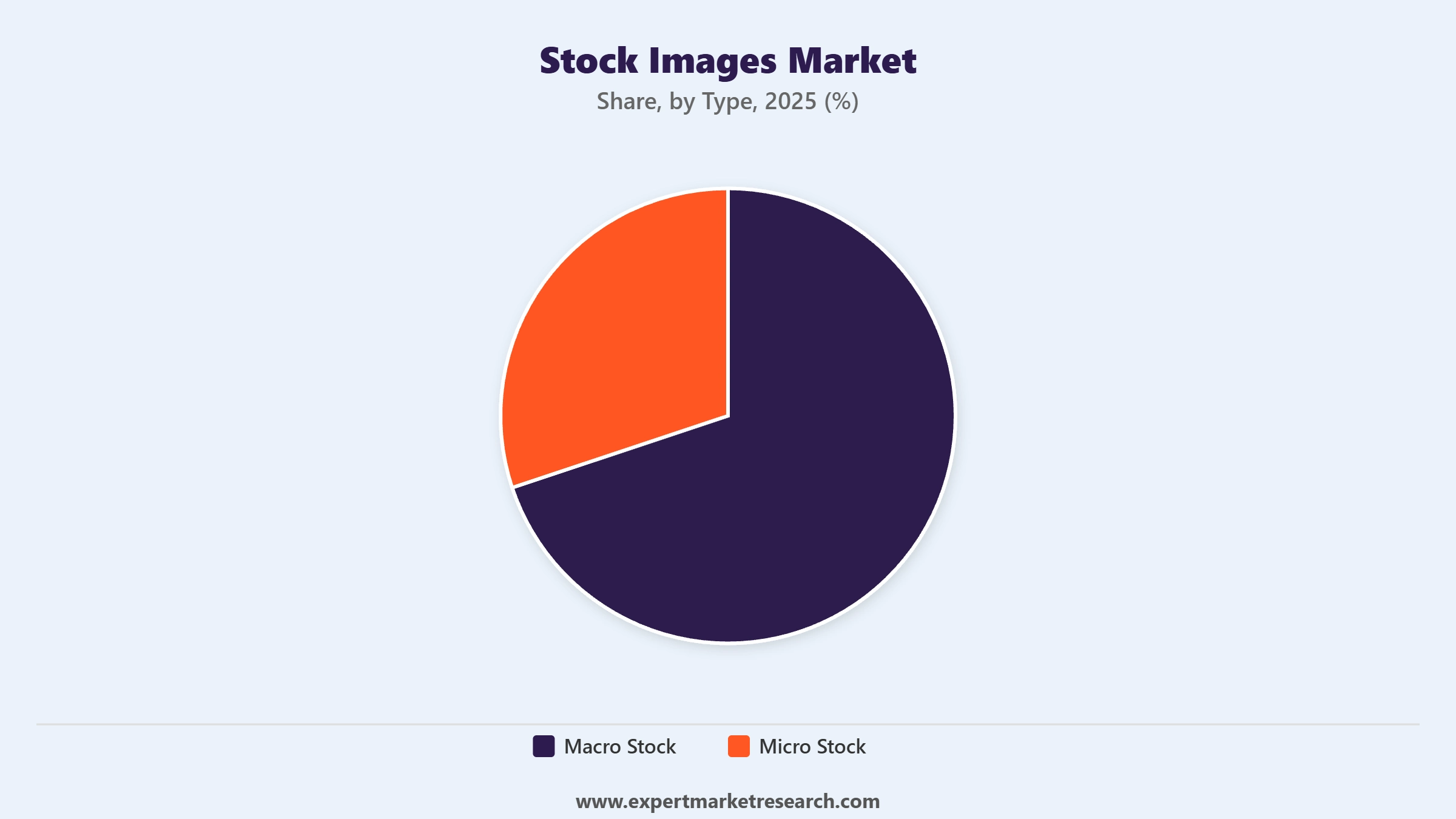
Market Breakup by Type
Key Insight: Macro stock images, characterized by higher pricing and exclusive licensing, appeal to agencies and publishers requiring unique, high-resolution visuals for branding and print. Micro stock, offering affordable, royalty-free content, dominates the online and SME segment. The growth of subscription models in microstock platforms, such as iStock and Depositphotos supports consistent demand. While macro stock continues to thrive in enterprise-level campaigns, micro stock drives volume, especially among social media marketers and e-commerce sellers looking for budget-friendly, reusable visuals.
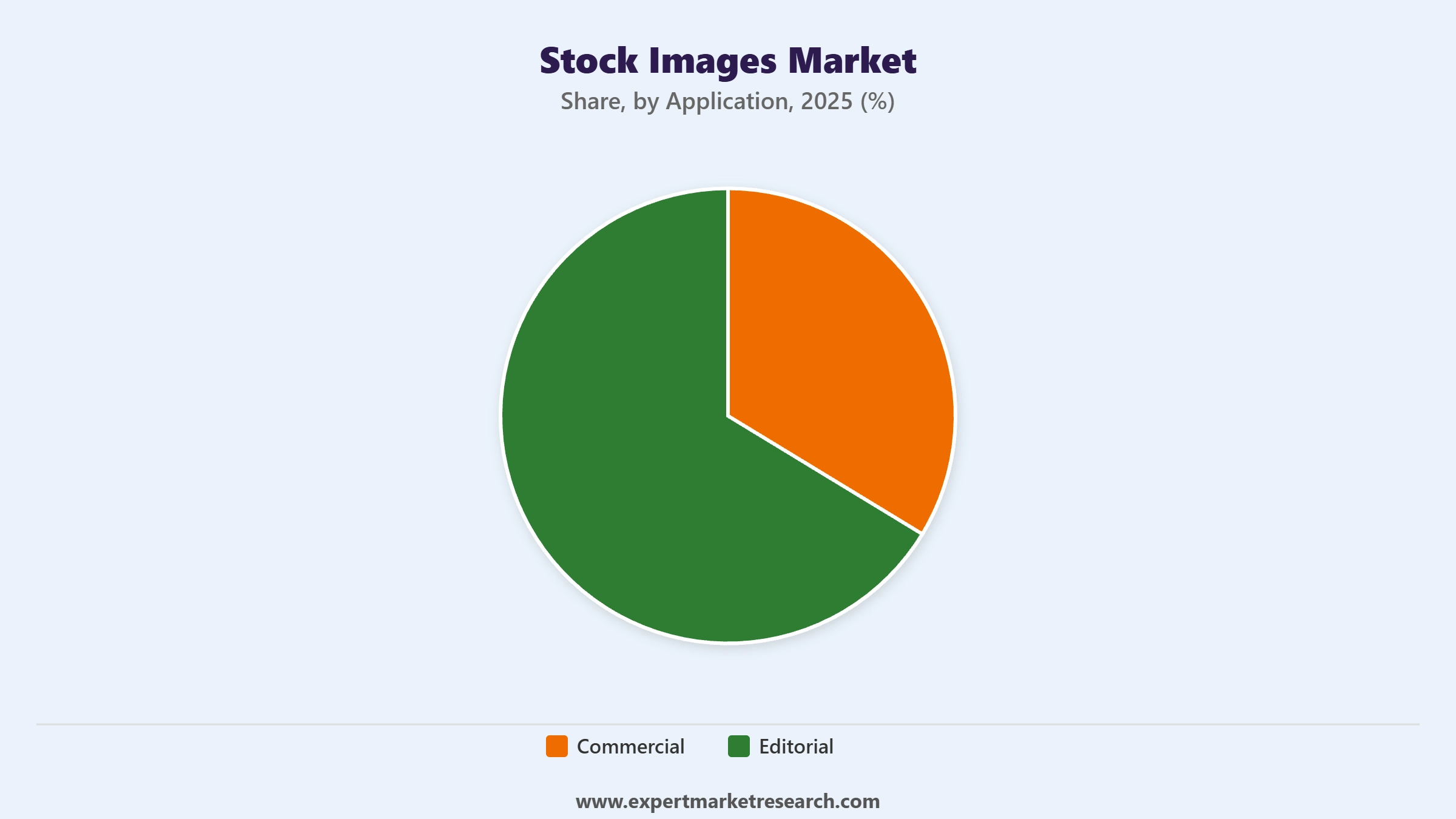
Market Breakup by Application
Key Insight: Commercial applications account for the majority of stock images market share, spanning digital marketing, advertising, websites, and product design. Brands increasingly demand images that match campaign tone and demographics. Editorial stock content is used by news media, blogs, and magazines to visually complement narratives. Global media houses like BBC and The Guardian also expanded their editorial licensing partnerships to access real-time and archive-based visuals, boosting the editorial image segment’s prominence in digital journalism and long-form content.
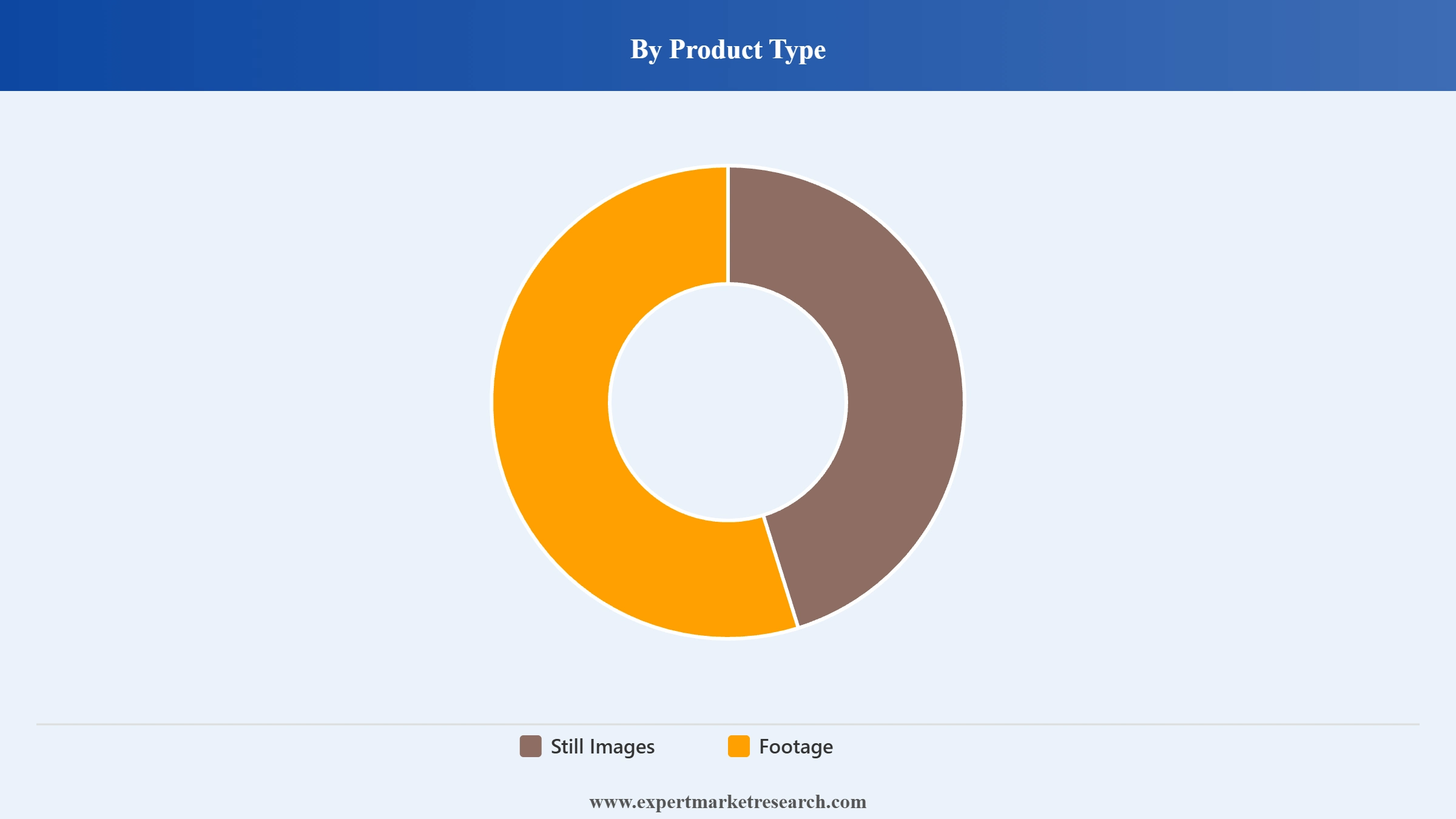
Market Breakup by Product Type
Key Insight: Still images continue to dominate due to ease of use, faster loading, and broader applicability across digital formats. However, demand for stock footage is rising, particularly for YouTube content, product demos, and social reels. Platforms like Pond5 and Videoblocks have seen increased usage from content creators needing high-quality b-roll and cinematic assets. In 2025, Shutterstock added vertical-format videos to cater to TikTok and Instagram creators. This segmentation reflects an evolving preference for dynamic storytelling across digital media channels.
Market Breakup by Region
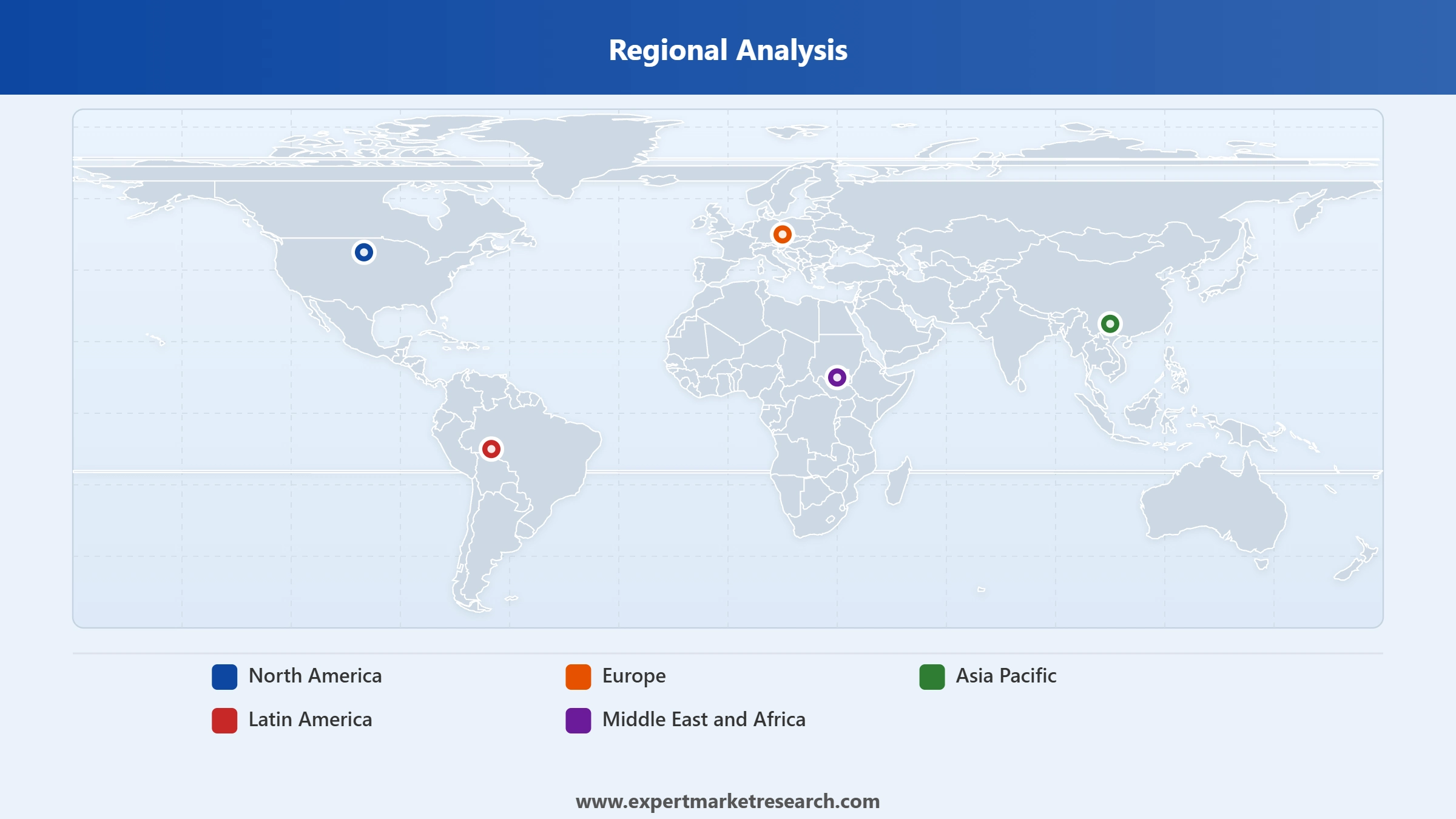
Key Insight: North America stock images industry leads due to mature digital marketing ecosystems and early adoption of AI design tools. Europe follows closely with a focus on GDPR-compliant and culturally diverse stock content. Asia Pacific is growing rapidly with rising content production in India, Southeast Asia, and Australia. Latin America is adopting cost-effective stock platforms for freelance and small-business use. In the Middle East and Africa, media digitization and mobile-first content creation are increasing stock image adoption, especially through free and subscription models.
Read more about this report - REQUEST FREE SAMPLE COPY IN PDF
Macro stock to lead the market due to better legal protection
The macro stock images market refers to premium, high-resolution images licensed at higher prices for exclusive or rights-managed use. This segment dominates in terms of revenue, primarily serving advertising agencies, media houses, and large corporations that demand unique, high-quality visuals. Getty Images is a major player in the macro stock market, offering editorial and commercial imagery with detailed rights control. Though costlier, macro stock images offer greater legal protection, usage flexibility, and artistic value, maintaining their dominance in professional use.
Read more about this report - REQUEST FREE SAMPLE COPY IN PDF
Micro stock includes royalty-free images sold at lower prices and typically under non-exclusive licenses. This segment dominates in terms of volume and accessibility, driven by platforms like Shutterstock, Adobe Stock, and iStock. Micro stock caters to bloggers, small businesses, marketers, and freelancers needing affordable, ready-to-use visuals. These platforms operate on subscription or credit-based models, enabling users to download high-quality visuals at scale. In June 2022, URPopular launched Coolwii Stock, a platform offering influencer‑based stock images and videos tailored for brands.
Commercial sector to capture significant share due to digital marketing expansion
Commercial stock images demand growth can be attributed to uses in marketing, advertising, and promotional purposes where the intent is to sell or promote a product, service, or brand. These images require model and property releases to ensure legal compliance. This segment dominates the stock image market due to its wide usage across social media, websites, e-commerce, and advertising campaigns. Platforms like Shutterstock, Adobe Stock, and Canva cater heavily to this demand. As digital marketing expands, commercial imagery remains the top revenue contributor.
Read more about this report - REQUEST FREE SAMPLE COPY IN PDF
Editorial stock images are intended for use in news, blogs, documentaries, or educational contexts where the imagery illustrates real-life events, people, or places. In June 2023, Shutterstock launched flexible editorial subscription packages, offering extensive access to entertainment, news, sports, and archival content for media professionals. While vital for journalism and storytelling, editorial content holds a smaller market share. Getty Images and Reuters dominate this segment, offering timely visuals from global news events like photos of political rallies, sports matches, or public figures.
Still Images to hold significant share due to innovations
Still images represent the largest segment of the stock images market. They include photographs, illustrations, and vectors used widely in advertising, editorial content, social media, websites, and presentations. Major platforms thrive on this demand, offering millions of ready-to-use visuals. In April 2024, VectorStock rolled out an unlimited subscription for vector collections, giving users access to over 38 million vector images, icons, and illustrations for a flat monthly or annual fee. Their affordability, ease of use, and visual versatility make still images a go-to resource for creators globally.
Read more about this report - REQUEST FREE SAMPLE COPY IN PDF
Footage, which includes short video clips, is a growing yet smaller segment in comparison to still images. This segment is increasingly used in video marketing, social media reels, documentaries, YouTube content, and advertising. Platforms like Pond5, Storyblocks, and Shutterstock Footage offer royalty-free and rights-managed video clips. For example, a YouTuber creating travel vlogs might use aerial drone footage of beaches or cities to enhance visual storytelling. The rise of video content across platforms like Instagram and TikTok is driving the segment’s growth.
Asia Pacific claims the dominant market position owing to a strong creator economy
North America holds the largest global stock images market share, supported by a well-established creator economy, high digital ad spends, and the widespread use of licensed images across e-commerce, education, and marketing. The United States and Canada also lead in innovation, offering integrated tools for content planning, design, and publishing. In May 2024, American SuperStock acquired Calgary’s All Canada Photos to broaden its global portfolio and incorporate rich Canadian-themed and multimedia content.
Read more about this report - REQUEST FREE SAMPLE COPY IN PDF
Asia Pacific is the fastest-growing market, fueled by rising internet penetration, digital entrepreneurship, and mobile-first marketing strategies. India, China, Indonesia, and the Philippines are seeing higher adoption of microstock images. Europe remains a major hub for editorial and lifestyle content, with strong legal compliance driving platform trust. Latin America and the Middle East are emerging markets, driven by local content demand, influencer growth, and bilingual content creation, creating strong potential for future expansion.
The global stock images industry is moderately concentrated, dominated by global platforms and an increasing number of regional and niche content suppliers. Market competition encompasses subscription models, on-demand licensing, and freemium hybrid offerings. Industry leaders such as Shutterstock, Getty Images, and Adobe Stock are investing in AI, automation, and global expansion to drive competitive edge.
Firms are spending on AI-driven search, customized recommendations, and generative image capabilities. Prompt-to-image software provides distinctive customization features through which users can create images from text. Strategic purchases are also influencing the industry. Localization is emerging as a differentiating strategy, with platforms curating local content to address increased demand for cultural representation. User experience, licensing flexibility, and integration with creative software are still top competitive levers.
Founded in 2003 and headquartered in New York City, the United States, Shutterstock is a global provider of stock images, videos, and music. The company pioneered a subscription-based licensing model and recently integrated generative AI into its platform, enhancing creative workflows and allowing users to produce unique visuals from simple text prompts.
Established in 1995 and based in Seattle, the United States, Getty Images is renowned for its extensive archive of editorial and creative content. It has played a key role in digitizing historical photography and offers premium imagery to global media and advertisers. Getty continues to innovate with AI-powered search and licensing solutions.
Adobe Inc., founded in 1982 and headquartered in San Jose, the United States, launched Adobe Stock in 2015. Integrated into Adobe Creative Cloud, Adobe Stock offers millions of high-quality assets. Its innovation lies in seamless software integration, AI-powered search via Adobe Sensei, and growing use of generative AI to support creative professionals.
Canva, founded in 2012 in Sydney, Australia, is a graphic design platform that simplifies content creation for non-designers. Known for its drag-and-drop interface, Canva offers access to stock photos, videos, and templates. It has expanded into enterprise tools and AI-based design features, enabling users to create professional visuals effortlessly.
Other key players in the stock images market include Dreamstime, 123RF, Envato Pty Ltd., Depositphotos, Alamy Ltd., and Pond5.
*Please note that this is only a partial list; the complete list of key players is available in the full report. Additionally, the list of key players can be customized to better suit your needs.*
Unlock critical insights with our Stock Images Market Report 2026. Understand key drivers, future trends, and growth opportunities shaping the industry. Download your free sample now to stay ahead in the evolving digital content landscape. Explore expert analysis on stock images market trends 2026, segmentation, and competitive strategies tailored for decision-makers.


Upto 15% Off
USD
$3999 $3599
$2499 $2249
$4999 $4249
$5999 $5099


*While we strive to always give you current and accurate information, the numbers depicted on the website are indicative and may differ from the actual numbers in the main report. At Expert Market Research, we aim to bring you the latest insights and trends in the market. Using our analyses and forecasts, stakeholders can understand the market dynamics, navigate challenges, and capitalize on opportunities to make data-driven strategic decisions.*
In 2025, the market reached an approximate value of USD 6.37 Billion.
The market is projected to grow at a CAGR of 6.60% between 2026 and 2035.
The market is estimated to witness a healthy growth in the forecast period of 2026-2035 to reach around USD 12.07 Billion by 2035.
Key strategies include expanding diverse and inclusive image libraries, adopting AI for smarter search and tagging, and offering flexible pricing models. Companies also focus on global contributor partnerships, video and vector content expansion, and seamless integration with creative software to enhance user experience and retention.
The key trends include the demand for stock images shot in real scenarios and the growth of the content creation economy.
The different types of stock images include still images and footage.
The major applications of stock images include commercial and editorial.
The key players in the market include Shutterstock, Inc., Getty Images, Inc., Adobe Inc. (Adobe Stock), Canva Pty Ltd., Dreamstime,123RF, Envato Pty Ltd., Depositphotos, Alamy Ltd. and Pond5.
Significant challenges include expanding subscription models, AI-driven content tagging, and personalized search capabilities. Platforms focus on diversifying content libraries, localizing visuals, and partnering with creators globally. Emphasis on licensing flexibility, video and 3D content, and integration with design tools further enhances user engagement and market growth.
Explore our key highlights of the report and gain a concise overview of key findings, trends, and actionable insights that will empower your strategic decisions.
| REPORT FEATURES | DETAILS |
| Base Year | 2025 |
| Historical Period | 2019-2025 |
| Forecast Period | 2026-2035 |
| Scope of the Report |
Historical and Forecast Trends, Industry Drivers and Constraints, Historical and Forecast Market Analysis by Segment:
|
| Breakup by Type |
|
| Breakup by Application |
|
| Breakup by Product Type |
|
| Breakup by Region |
|
| Market Dynamics |
|
| Competitive Landscape |
|
| Companies Covered |
|
| Report Price and Purchase Option | Explore our purchase options that are best suited to your resources and industry needs. |
| Delivery Format | Delivered as an attached PDF and Excel through email, with an option of receiving an editable PPT, according to the purchase option. |
Single User License
One User
USD 3,999
USD 3,599
tax inclusive*
Datasheet
One User
USD 2,499
USD 2,249
tax inclusive*
Five User License
Five User
USD 4,999
USD 4,249
tax inclusive*
Corporate License
Unlimited Users
USD 5,999
USD 5,099
tax inclusive*
*Please note that the prices mentioned below are starting prices for each bundle type. Kindly contact our team for further details.*
Flash Bundle
Small Business Bundle
Growth Bundle
Enterprise Bundle
*Please note that the prices mentioned below are starting prices for each bundle type. Kindly contact our team for further details.*
Flash Bundle
Number of Reports: 3
20%
tax inclusive*
Small Business Bundle
Number of Reports: 5
25%
tax inclusive*
Growth Bundle
Number of Reports: 8
30%
tax inclusive*
Enterprise Bundle
Number of Reports: 10
35%
tax inclusive*
How To Order

Select License Type
Choose the right license for your needs and access rights.

Click on ‘Buy Now’
Add the report to your cart with one click and proceed to register.

Select Mode of Payment
Choose a payment option for a secure checkout. You will be redirected accordingly.
Strategic Solutions for Informed Decision-Making
Gain insights to stay ahead and seize opportunities.

Get insights & trends for a competitive edge.

Track prices with detailed trend reports.

Analyse trade data for supply chain insights.

Leverage cost reports for smart savings

Enhance supply chain with partnerships.

Connect For More Information
Our expert team of analysts will offer full support and resolve any queries regarding the report, before and after the purchase.
Our expert team of analysts will offer full support and resolve any queries regarding the report, before and after the purchase.
We employ meticulous research methods, blending advanced analytics and expert insights to deliver accurate, actionable industry intelligence, staying ahead of competitors.
Our skilled analysts offer unparalleled competitive advantage with detailed insights on current and emerging markets, ensuring your strategic edge.
We offer an in-depth yet simplified presentation of industry insights and analysis to meet your specific requirements effectively.




