

Consumer Insights
Uncover trends and behaviors shaping consumer choices today
Procurement Insights
Optimize your sourcing strategy with key market data
Industry Stats
Stay ahead with the latest trends and market analysis.

The global rheology modifiers market size reached around USD 6.56 Billion in 2025. The market is projected to grow at a CAGR of 3.70% between 2026 and 2035 to reach nearly USD 9.43 Billion by 2035.
There has been growing demands in the market for a wide range of applications. In paints & coatings, these modifiers improve the performance and stability of the product. Moreover, these are being used in the personal care and cosmetics industries also, to obtain better texture and application. Similarly, the petroleum industry uses rheology modifiers to make transport more efficient in regard to shale gas and crude oil production. With these markets growing, demand for new rheology modifiers also continues to grow, leading to market growth worldwide.
Base Year
Historical Period
Forecast Period
Compound Annual Growth Rate
3.7%
Value in USD Billion
2026-2035
*this image is indicative*
Read more about this report - REQUEST FREE SAMPLE COPY IN PDF
Trends in the rheology modifiers market include the increasing advancement in materials science; making better products with mechanical behavior properties. These modifiers improve viscosity, stress, and strain in paints, coatings and cosmetics for better application and product performance. Rising demand for customized rheological properties can be observed in the pharmaceutical, inks and food & beverage industries. This reflects an increased emphasis on fine-tuning of rheology parameters for improved end-product quality and functionality.
This phenomenon is further enhancing the growth of multiple industries, and rheology modifiers are at the forefront of this growth, particularly in paints, coatings, and personal care products. The increased application of rheology modifiers has resulted in the introduction of advanced additives providing improved viscosity control, such as the ability to achieve shear thickening and shear thinning. These modifiers help to improve texture, shelf stability and processability. Foremost components including K-carrageenan, arginine, laponite and xanthan gum enable to change the viscosity magnitude and ensure appropriate viscosity. Hence, these factors are anticipated to drive further market growth over the forecast period.
The rheology modifiers market is witnessing a healthy competitive landscape with both organic and inorganic producers indulging in creative means to acquire the bulk of the market share. This in turn reflects companies that are now investing more in research and development to provide an extensive product portfolio to cater to a variety of customer base. Based on the advanced rheology modifiers provided, prominent companies are seeking innovative ways to gain the higher share of the market.
As per the market report, the demand for rheology modifiers stands high due to two primary factors. Market share expansion requires contractual agreements and collaboration and strategic initiatives. Companies are ramping up their investments in product launches and partnerships to fortify their footprint in the market. Companies are pouring in several initiatives seeking to foster innovation and improve market penetration, capitalizing on changing consumer preferences.
The demand for rheology modifiers is primarily driven by the end-use industries, among which, paints & coatings is a major source of demand. Xanthan Gum, a rheology modifier that contributes to improved flow, texture, is widely used in paints and coatings, ultimately leading to better finishes and stability. High demand is found in the personal care and cosmetics industries, as well, where rheology modifiers ensure products such as creams, lotions and shampoos meet the texture, stability and spread ability needs. Moreover, the pharmaceuticals industry requires rheology modifiers to develop controlled-release formulations, as well as to adjust product consistency. Similarly, the oil & gas industry utilizes these modifiers to optimize drilling fluids as well as enhance production processes.
In the construction industry rheology modifiers play an important role to enhance the workability and durability of cement and concrete. In sealants and adhesives, these modifiers help create viscosity and tackiness, enabling bonding. Rheology modifiers are widely used in textiles to improve the performance of fabrics, providing them with properties including smoothness and wrinkle resistance. These applications underline the vast reach in terms of the market's impact across multiple sectors, which drives the market.
In the rheology modifiers market, the direct distribution channel is the most prominent channel type for the manufacturers, as it seeks to provide a more concise, and cost-effective supply chain. Sales made directly to the end customer help the producers better control delivery of a product, price, and customer relations. This channel is especially relevant to building solid, long-term partnerships within revenue-generating customers in target markets including paints & coatings, personal care and pharmaceuticals.
On the other hand, the indirect distribution channel helps in widening market reach through the use of third-party distributors, retailers, and wholesalers. With this distribution channel, manufacturers can penetrate regional markets with varied offerings, catering to more customers. Such channels are particularly useful to small players or new entrants in specific geographical regions. By using indirect channels, companies can reach a wider customer base, assuring availability of their products through multiple sectors such as construction and textiles.
Read more about this report - REQUEST FREE SAMPLE COPY IN PDF
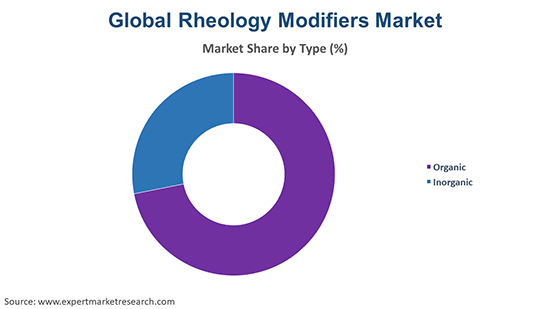
The organic rheology modifiers segment is projected to be convenient due to their use in sustainable and eco-friendly products. These organic modifiers are derived from natural sources that are best suited for application in cosmetics, personal care and paints. Such demand is a result of increasing consumer trend towards natural ingredients and sustainable products. Organic rheology modifiers are gaining popularity in several end-use industries, as it allows them to provide improved stability and ease of application.
However, in contrast, the oil & gas, construction, and pharmaceutical industries have much higher performance specifications. These industries require inorganic rheology modifiers. These modifiers are typically comprised of minerals and man-made materials which enhance viscosity and endurance in extreme conditions. They provide easy handling, tremendous temperature, and mechanical stress resistance in arduous applications and thus help in maintaining their market lead across industrial verticals.
Liquid rheology modifiers present a cost-effective solution, which is likely to considerably contribute to the rapid pace of adoption across industrial applications. Liquid rheology modifiers facilitate a smooth dispersion and are easy to implement in the formulations and contribute to the typically superior rheological performance and product stability. This is in direct relation to the increasing demand for sustainable products that reduce environmental footprint.
The solid rheology modifiers, however, are more preferred for stability and long-term shelf life applications, such as construction and adhesives. Solid forms allow for better release control and durable performance in extreme environments. Their stable forms which can be stored and handled more easily makes formulations possible in which solid, contained structure and strength is required.
Growing environmental concern and environmental regulations create demand for water-based rheology modifier, which is compatible with several applications including paints, coatings and personal care. These modifiers help maintain viscosity, intensity and stability without having to use extreme solvents, making them ideal for natural or eco formulations.
In oil & gas and industrial coatings markets, conditions of extremity of performance dictate the deployment of solvent based rheology modifiers. These modifiers offer great viscosity control and solvent stability while supporting the best flow characteristics. Solvent based formulations are critical for high performance, chemical resistance and durability in demanding applications although they have their environmental challenges.
There are a variety of functions of rheology modifiers. Thickeners play one of the main roles in the products of providing viscosity, which helps maintain an optimal texture and consistency of paints and coatings and cosmetic products. They have many applications other than hygroscopic behavior, including leveling agents. In addition, they impart a shear-thinning characteristic to the product that improves application performance and long-term stability during storage.
Industrial applications such as oil & gas considerably benefit from the impact of depressants on reducing friction and ensuring better flow. Though to make formulations less viscous for a better spread thinners becomes a necessity. These elements cater to particular requirements across industries and guarantee the compliance of products with required performance and application-centric specifications among numerous end-use domains.

United States Rheology Modifiers Market Trends
The United States rheology modifiers market is witnessing a steady rise. The growth of the market is driven by increased demand across industries for paints, coatings, and personal care. Environmental considerations are driving regional companies to make hefty investments on eco-friendly, water-based rheology niters. Furthermore, the market growth is supported by the emergence of new product formulations, as companies are attempting to fulfill rising consumer demand for effective green forms.
Asia Pacific Rheology Modifiers Market Trends
The Asia Pacific region is fast emerging as a key demand generating region for rheology modifiers due to increasing industrialization and urbanization. Demand is strongest in the paints, coatings and construction sectors, most of it stemming from countries like China and Japan. Growing consumer inclinations towards personal care and cosmetics products are also driving the growth of the market. Furthermore, oil and gas development is expected to increase rheology modifiers demand in the region, especially in oilfield applications including drilling and fluid systems.
India Rheology Modifiers Market Trends
The market for rheology modifiers in India is being driven by a number of factors, particularly the rising use of rheology modifiers by industries, including construction, paints, and textiles. Between March 2023 and February 2024, India imported 2,102 shipments of rheology modifiers, marking it as the leading importer globally, followed by Russia with 714 shipments and Vietnam with 588. High-performance coatings and adhesives driving heavy market demands. Additionally, the increasing consumer expenditure will be further translating into market growth for the personal care industry.
Saudi Arabia Rheology Modifiers Market Trends
The Saudi Arabian rheology modifiers market is being promoted by the power packed growth of oil & gas industry in the region, which are vital for drilling and fluid systems. The market is evolving due to growing demand for high-performance coatings, in addition to the construction and automotive industries. Moreover, the focus on economic diversification of the government through Vision 2030 has attracted large-scale investments towards infrastructure and industrial projects, further expanding the market.
Brazil Rheology Modifiers Market Trends
In Brazil, the rheology modifiers market is mainly driven by the growing demand for paints & coatings, particularly from the construction and automotive industries. The growing personal care industry in the country is another factor driving the growth of the market. With Brazil’s industrial production on the rise, so is the need for efficient rheology modifiers used in adhesive and sealant applications. Furthermore, investment in oil and gas industries are another key driver for more demand within the market.
The major players in the rheology modifiers market are focusing on expanding their product portfolio through the research and development of new technologies and collaboration with other companies as well as the acquisition of companies. Market players are constantly optimizing their market footprint and pushing industry growth by leveraging the heavy demand across paints, coatings, personal care and oil and gas sectors.
BASF SE is a leading company that delivers a complete set of high-performing products with applications in industry sectors like coatings, paints, and personal care. The company delivers innovative products focusing on sustainability, ecofriendly modifiers, and water-based modifiers that enhance viscosity, texture, and stability in formulating.
Arkema LLC provides organic and inorganic rheology modifiers to cater for multiple end-use applications. Additionally, through innovative natural and bio-based materials, the company delivers products to increase performance, stability and workability of paints, coatings, adhesives, and other personal care formulations while meeting complex regulatory and environmental challenges.
Clariant AG is a worldwide producer of rheology modifiers around high-performance additives across industries like paints coatings, textiles, and personal care. The company provides a diverse portfolio that supports sustainable development and eco-focused solutions including designs that improve viscosity, texture, and application, with impact to product stability and performance across a broad range of formulations.
Croda International Plc is a global leader in rheology modifiers for innovative and sustainable solutions in personal care, paints and coatings. They have different types of modifiers that improve functionality, stability and texture in their products, as well as are committed to environmental sustainability and unique formulation technologies.
*Please note that this is only a partial list; the complete list of key players is available in the full report. Additionally, the list of key players can be customized to better suit your needs.*
The study on the rheology modifiers market delivers detailed analysis on region-level perspective depending on specific contemporary industry trends. It considers various segments, such as end use, distribution channel, type, form, formulation, and functionality. By assessing all these segments, this report presents a thorough discussion of market drivers, regulations, and emerging opportunities observed in the market.
Type Outlook (Revenue, Billion, 2026-2035)
Form Outlook (Revenue, Billion, 2026-2035)
Formulation Outlook (Revenue, Billion, 2026-2035)
Functionality Outlook (Revenue, Billion, 2026-2035)
End Use Outlook (Revenue, Billion, 2026-2035)
Distribution Channel Outlook (Revenue, Billion, 2026-2035)
Region Outlook (Revenue, Billion, 2026-2035)


Upto 15% Off
USD
$2499 $2249
$3999 $3599
$4999 $4249
$5999 $5099


*While we strive to always give you current and accurate information, the numbers depicted on the website are indicative and may differ from the actual numbers in the main report. At Expert Market Research, we aim to bring you the latest insights and trends in the market. Using our analyses and forecasts, stakeholders can understand the market dynamics, navigate challenges, and capitalize on opportunities to make data-driven strategic decisions.*
Get in touch with us for a customized solution tailored to your unique requirements and save upto 35%!
In 2025, the market attained a value of nearly USD 6.56 Billion.
The market is assessed to grow at a CAGR of 3.70% between 2026 and 2035.
The market is estimated to witness a healthy growth in the forecast period of 2026-2035 to reach about USD 9.43 Billion by 2035.
The major drivers of the market include rising disposable incomes, increasing demand for premium products in the personal care industry, and the growing pharmaceuticals sector.
The versatile functionalities of rheology modifiers, changing economic conditions in developing nations, and rising demand for paints, adhesives, and coatings in the construction sector are expected to be the key trends of the market.
North America, Europe, the Asia Pacific, Latin America, and the Middle East and Africa are the major regions in the market.
The different types of rheology modifiers in the market are organic and inorganic.
The leading forms of rheology modifiers in the market are liquid and solid.
The major formulations of rheology modifiers are water based and solvent based.
The various functionalities of rheology modifiers in the market are levelling agent, depressants, thinner, thickener, and thixotropic agents, among others.
The different end users of rheology modifiers in the market are sealants and adhesives, paints and coatings, cosmetics and personal care, oil and gas, construction, pharmaceuticals, and textiles, among others.
The key players in the global rheology modifiers market are BASF SE, Arkema LLC, Clariant AG, Croda International Plc, The Lubrizol Corporation, The Dow Chemical Company, Elementis PLC, Ashland, Akzo Nobel N.V., BYK Additives & Instruments, Cargill Incorporated, DuPont, Evonik Industries AG, and PPG Industries, among others.
Asia Pacific accounted for the largest market share in 2025.
Explore our key highlights of the report and gain a concise overview of key findings, trends, and actionable insights that will empower your strategic decisions.
| REPORT FEATURES | DETAILS |
| Base Year | 2025 |
| Historical Period | 2019-2025 |
| Forecast Period | 2026-2035 |
| Scope of the Report |
Historical and Forecast Trends, Industry Drivers and Constraints, Historical and Forecast Market Analysis by Segment:
|
| Breakup by Type |
|
| Breakup by Form |
|
| Breakup by Formulation |
|
| Breakup by Functionality |
|
| Breakup by End Use |
|
| Breakup by Distribution Channel |
|
| Breakup by Region |
|
| Market Dynamics |
|
| Competitive Landscape |
|
| Companies Covered |
|
| Report Price and Purchase Option | Explore our purchase options that are best suited to your resources and industry needs. |
| Delivery Format | Delivered as an attached PDF and Excel through email, with an option of receiving an editable PPT, according to the purchase option. |
Datasheet
One User
USD 2,499
USD 2,249
tax inclusive*
Single User License
One User
USD 3,999
USD 3,599
tax inclusive*
Five User License
Five User
USD 4,999
USD 4,249
tax inclusive*
Corporate License
Unlimited Users
USD 5,999
USD 5,099
tax inclusive*
*Please note that the prices mentioned below are starting prices for each bundle type. Kindly contact our team for further details.*
Flash Bundle
Small Business Bundle
Growth Bundle
Enterprise Bundle
*Please note that the prices mentioned below are starting prices for each bundle type. Kindly contact our team for further details.*
Flash Bundle
Number of Reports: 3
20%
tax inclusive*
Small Business Bundle
Number of Reports: 5
25%
tax inclusive*
Growth Bundle
Number of Reports: 8
30%
tax inclusive*
Enterprise Bundle
Number of Reports: 10
35%
tax inclusive*
How To Order

Select License Type
Choose the right license for your needs and access rights.

Click on ‘Buy Now’
Add the report to your cart with one click and proceed to register.

Select Mode of Payment
Choose a payment option for a secure checkout. You will be redirected accordingly.
Gain insights to stay ahead and seize opportunities.

Get insights & trends for a competitive edge.

Track prices with detailed trend reports.

Analyse trade data for supply chain insights.

Leverage cost reports for smart savings

Enhance supply chain with partnerships.

Connect For More Information
Our expert team of analysts will offer full support and resolve any queries regarding the report, before and after the purchase.
Our expert team of analysts will offer full support and resolve any queries regarding the report, before and after the purchase.
We employ meticulous research methods, blending advanced analytics and expert insights to deliver accurate, actionable industry intelligence, staying ahead of competitors.
Our skilled analysts offer unparalleled competitive advantage with detailed insights on current and emerging markets, ensuring your strategic edge.
We offer an in-depth yet simplified presentation of industry insights and analysis to meet your specific requirements effectively.





Share