

Consumer Insights
Uncover trends and behaviors shaping consumer choices today
Procurement Insights
Optimize your sourcing strategy with key market data
Industry Stats
Stay ahead with the latest trends and market analysis.

The plastic cups market attained a value of USD 15.97 Billion in 2025. The market is expected to grow at a CAGR of 8.30% during the forecast period of 2026-2035. By 2035, the market is expected to reach USD 35.45 Billion.
Governments worldwide impose bans and restrictions on single-use plastic items, including cups, to combat pollution. Such regulations force manufacturers and retailers to innovate and shift towards recyclable, compostable, or reusable solutions. In July 2025, Huhtamaki launched new ice cream cups that are home and industrially compostable and recyclable. Compliance further drives market changes, fostering product diversification and increasing investment in circular economy practices.
Innovations in plastic materials, such as advanced polymers and foamed plastics, are driving the plastic cups market expansion for improving performance by reducing weight and maintaining strength. Technologies like Bantam™ and chemical recycling feedstocks enable the production of cups that are more sustainable and cost-efficient. Design innovations include improved stack ability, insulation, and user-friendly features that enhance consumer experience. These technological advances allow manufacturers to meet both environmental goals and consumer expectations for convenience and durability.
Base Year
Historical Period
Forecast Period
Compound Annual Growth Rate
8.3%
Value in USD Billion
2026-2035
*this image is indicative*
The plastic cups market is increasingly driven by sustainability concerns. Consumers and regulators push for biodegradable, compostable, and recyclable materials to reduce environmental impact. Brands are adopting bio-based plastics, recycled PET, and innovations that are easier to recycle.
In May 2024, Sulapac partnered with Burger King Finland to pilot 100% bio-based reusable cups made from Sulapac Solid, a biodegradable material. This shift aims to balance convenience with reduced plastic pollution, responding to growing consumer demand for green products and compliance with stricter environmental laws worldwide.
Rising environmental awareness fuels the demand for reusable plastic cups. Hospitality sectors, events, and retail chains launch reusable cup programs to cut single-use waste. These cups offer durability and often integrate deposit-return systems, incentivizing returns.
In June 2025, Lisbon launched Europe’s first city-wide reusable cup system to reduce plastic waste and boost sustainability. Such instances support circular economy initiatives, aligns with global sustainability targets, and helps businesses reduce waste management costs while enhancing their green credentials.
The rise of on-the-go lifestyles, especially among younger demographics, fuels demand for portable beverage containers, adding to the plastic cups industry revenue to offer lightweight, durable, and disposable or reusable options. Growth in coffee shops, fast food, and convenience stores amplifies this trend.
In May 2025, Starbucks introduced a new compostable and recyclable hot cup in Europe, replacing plastic linings with a mineral-based coating and plastic lids with fiber alternatives. Cups designed for hot and cold drinks with secure lids and ergonomic designs support convenience, hygiene, and brand differentiation.
Consumers are more environmentally conscious, seeking products with lower carbon footprints and less waste. This awareness influences purchasing decisions, with many willing to pay premiums for eco-friendly cups.
Consumer education campaigns by brands and governments enhance this trend, pushing manufacturers toward sustainable innovations and transparency in sourcing and lifecycle impacts. For instance, in August 2024, Petaluma, California introduced the nation's first citywide reusable cup program, aiming to reduce landfill waste.
Environmental impact assessments drive manufacturers to reduce the carbon footprint in the plastic cups market via sourcing, production, and end-of-life management.
In April 2025, First Editions introduced FOAMO, a reusable coffee cup crafted from renewable plant-based polypropylene. This focus aligns with corporate sustainability commitments and regulatory demands, shaping product design and supply chain choices toward low-carbon solutions.
Read more about this report - REQUEST FREE SAMPLE COPY IN PDF
The Expert Market Research’s report titled “Plastic Cups Market Report and Forecast 2026-2035” offers a detailed analysis of the market based on the following segments:
Market Breakup by Nature
Key Insight: Disposable plastic cups dominate quick-service environments, events, and takeaways due to convenience and cost-effectiveness. Typically made from PET, PS, or PP, these cups are designed for single use and then discarded. The growing environmental concerns are driving shifts toward compostable or recyclable options within this segment. In November 2024, Lumi, a Los Angeles-based startup, introduced the LumiCup, a lightweight, endlessly recyclable aluminium cup designed to replace single-use plastic cups.
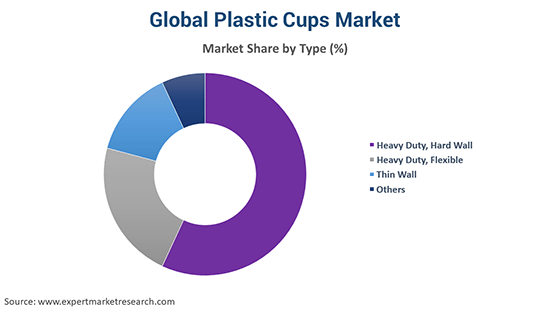
Market Breakup by Type
Key Insight: The heavy duty, hard wall segment of the plastic cups market features thick, rigid walls providing durability and insulation, ideal for hot beverages like coffee or tea. They are common in cafes and restaurants where sturdiness and heat resistance matter. For example, Starbucks’ hard wall cups with compostable coatings maintain shape under heat. Heavy duty hard wall cups also balance robustness with environmental innovations such as recyclable or bio-based materials.
Market Breakup by Raw Material
Key Insight: The polylactic acid (PLA) segment is gaining traction as it is a biodegradable, bio-based polymer derived from renewable resources. PLA cups are popular in sustainable packaging due to their compostability and lower carbon footprint. In May 2023, TotalEnergies Corbion and Coexpan introduced a new line of biobased cups made entirely from recycled PLA. Innovations are also improving PLA’s durability and integration into composting systems, making it a preferred choice for chilled beverages and events emphasizing green credentials.
Market Breakup by Distribution Channel
Key Insight: The institutional distribution channel segment of the plastic cups market includes bulk sales to businesses, such as cafes, restaurants, hotels, and event venues. These customers demand large volumes of plastic cups tailored for high usage and compliance with sustainability policies. For example, the Lisbon reusable cup network targets hospitality chains to minimize disposable cup waste. Institutional buyers prioritize durability, cost efficiency, and recyclability to align with corporate ESG goals, driving innovation and adoption of reusable or compostable cup solutions.
Market Breakup by Application
Key Insight: Plastic cups designed for cold drinks like soft drinks, iced coffee, smoothies, and water dominate the chilled food and beverages segment. Materials, such as PLA, PET and PP are popular due to clarity and strength. In October 2024, Bioleader launched fully compostable clear PLA cups designed for iced drinks and smoothies. Innovations focus on improving insulation and recyclability. Event catering and fast-food chains are key users, prioritizing lightweight, stackable, and recyclable options for convenience and sustainability.
Market Breakup by End Use
Key Insight: The plastic cups market spans diverse applications, each with unique demand patterns. QSRs and fast-food shops drive consistent high-volume orders through urbanised consumption habits, while the ice cream industry delivers seasonal surges supported by packaging innovation. Offices and institutions sustain predictable demand through bulk catering needs, and residential use benefits from growing preferences for disposable convenience during social gatherings.
Market Breakup by Region
Key Insight: Globally, the industry exhibits diverse regional dynamics. North America sustains its dominance through established beverage culture and brand-driven QSR networks, while Asia Pacific outpaces others in growth via rapid foodservice expansion. Europe, though moderated by regulatory pressures, leverages innovation in recyclable and compostable materials to maintain competitiveness. Plastic cups demand in Latin America spikes seasonally, supported by dessert and beverage sales in warm climates. The Middle East and Africa draw demand primarily from hospitality and tourism, where disposables align with hygiene expectations.
Read more about this report - REQUEST FREE SAMPLE COPY IN PDF
Non-Disposable & Recyclable Plastic Cups to Gain Traction
The non-disposable plastic cups market value is dominating as they are reusable and found mainly in households, offices, and hospitality sectors aiming to reduce waste. These cups, often made from durable polypropylene or Tritan, are designed for repeated use and easy cleaning. Brands like First Editions produce reusable coffee cups using plant-based polypropylene, highlighting innovation in this space. Non-disposable cups contribute to waste reduction by extending product lifecycle.
Recyclable plastic cups are made from materials, such as PET or PP that can be reprocessed after use, aligning with circular economy goals. In May 2025, Borealis and Finnish dairy company Valio introduced yogurt cups made from with 30% chemically recycled content. This segment is growing due to stricter regulations and consumer demand for sustainable packaging, supporting waste reduction while maintaining single-use convenience.
Surging Deployment of Heavy Duty, Flexible & Thin Wall Plastic Cups
Flexible heavy duty plastic cups demand is rising to combine durability with bendability, in cold beverages, such as smoothies or iced drinks. These cups can absorb impact without cracking, making them suitable for outdoor events or fast-food chains. Their flexibility also allows easier stacking and transport. Innovations in polymer blends enhance their strength while reducing plastic content, aligning with sustainability trends.
Meanwhile, thin wall plastic cups are lightweight as well as cost-effective, and are mainly used for cold drinks at large events or vending machines. They use less plastic, making them cheaper but more fragile than heavy duty options. The surging integration of technologies for ensuring recyclability is also boosting segment growth. In October 2022, Borealis and Bockatech unveiled reusable and thin wall cups made using EcoCore foam injection technology with Borealis PP, cutting plastic use by up to 50%.
Polypropylene & Polystyrene Plastic Cups to Record Preference
The polypropylene (PP) plastic cups industry is widely used for its toughness, chemical resistance, and heat tolerance, making it suitable for both hot and cold beverages. Recyclable PP cups, such as those from Berry Global, feature lightweight designs and rigidity bands to reduce plastic use while maintaining strength. PP’s recyclability and ability to withstand heat make it a preferred raw material for reusable and disposable cups in cafes and fast-food chains.
Polystyrene (PS) is favoured for its clarity and rigidity, commonly used in single-use cold beverage cups and lids. Several companies are innovating with expanded polystyrene or incorporating recycled content to address sustainability concerns, but regulatory pressures are encouraging a shift towards more recyclable alternatives. In May 2024, Avient, Borealis, Bockatech and MCC introduced EcoCore foam cups, a recyclable, lightweight EPS alternative cutting plastic density by ~70% in cup design.
Retail Sector to Boost Plastic Cups Usage
Retail distribution in the plastic cups market covers supermarkets, convenience stores, and online sales where consumers purchase plastic cups for personal use or small gatherings. Retail cups are typically smaller packs of disposable or reusable cups, often marketed with sustainability labels to attract eco-conscious buyers. In March 2024, Marks & Spencer UK rolled out new fully recyclable cups across over 300 of its cafés and food halls located within supermarkets and retail food halls. This channel supports innovative products, such as limited-edition designs and bio-based cups, meeting consumer trends for convenience combined with environmental responsibility.
Increasing Plastic Cups Demand for Hot Food and Beverages
The hot food and beverages segment is rapidly growing as hot drinks, such as coffee and tea require heat resistance and insulation. Heavy duty, hard wall PP cups with compostable coatings are common. Starbucks and Huhtamäki have launched compostable hot cups to reduce plastic waste. The segment demands materials that can withstand high temperatures without deformation, with increasing emphasis on reusable options to minimize single-use plastic footprints in cafes and office environments.
By end use, QSR and fast food shops dominate the market due to on-the-go consumption
Quick service restaurants (QSRs) dominate the plastic cups industry as they rely heavily on lightweight, cost-effective, and custom-printed options for cold beverages and takeaway orders. This sector benefits from urban dining patterns, where customers prioritise portability and hygiene. In densely populated regions, franchise chains demand bulk volumes, often tied to promotional campaigns requiring branded cups. The flexibility to produce cups in varied sizes and with recyclable or biodegradable materials makes them attractive under evolving sustainability standards.
The ice cream industry is emerging as the fastest-growing category in terms of plastic cups consumption, largely due to the sector’s move towards portion-controlled packaging and ready-to-eat formats. Retailers and parlours increasingly opt for plastic cups with tamper-proof lids for hygiene and shelf-life preservation. Seasonal demand peaks, particularly during summer festivals and tourist seasons, create high-volume purchase cycles. Cup suppliers offering custom designs, transparent materials for visual appeal, and eco-friendly alternatives gain a competitive edge.
North America leads the market due to established QSR chains and cold beverage culture
North America largely contributes to the plastic cups market value, due to the entrenched culture of takeaway beverages and an extensive network of QSR chains. Cold coffee, iced tea, smoothies, and soft drinks form staple offerings in both urban and suburban outlets. The region also leads in adopting customised, branded cup designs to enhance marketing recall. Stringent hygiene expectations post-pandemic have reinforced disposable packaging as a preferred solution in foodservice. Additionally, integrated recycling programmes in states like California encourage the use of recyclable PET and polypropylene variants.
The plastic cups market in Asia Pacific is experiencing accelerated growth, driven by rapid urbanisation, a swelling middle class, and the aggressive expansion of foodservice chains. Markets such as India, China, and Southeast Asia are witnessing a surge in takeaway orders and street-food culture, where low-cost, single-use cups meet the need for convenience. Cup manufacturers in the region benefit from relatively lower production costs, allowing competitive pricing in bulk orders.
Key players in the plastic cups market are focusing on sustainability, innovation, and meeting evolving consumer demands. Many companies prioritize developing recyclable, compostable, and reusable cups to address growing environmental concerns and regulatory pressures. Incorporating bio-based plastics and reducing plastic content in products is common to enhance eco-friendliness while maintaining durability and usability. Partnerships and collaborations with cities, retailers, and recycling firms help expand reusable cup networks and deposit-return systems, promoting circular economies.
Technological advancements, like lightweight designs and improved barrier coatings, reduce material use and enhance product performance. Brand differentiation via limited-edition designs, customization, and collector’s editions attract consumers seeking unique or branded experiences. Market players also focus on cost optimization by leveraging advanced manufacturing processes such as and Bantam technology, reducing material consumption and carbon footprint. Collectively, these strategies help companies stay competitive while advancing environmental responsibility in the plastic cups industry.
Founded in 1920 and headquartered in Espoo, Finland, Huhtamäki Oyj specializes in sustainable food packaging solutions. The company is recognized for its innovations in compostable and recyclable cups, incorporating bio-based coatings and materials. With a strong focus on eco-friendly development, Huhtamäki leads global efforts to reduce plastic waste.
Established in 1927 and based in Atlanta, the United States, Georgia-Pacific Consumer Products focuses on producing sustainable paper and packaging products. Known for advancing recyclable and compostable cup technologies, the company continually innovates to reduce environmental impacts in foodservice packaging worldwide.
Founded in 1960 with headquarters in Mason, the United States, Dart Container Corporation is a leading manufacturer of plastic and foam drinkware. The company emphasizes lightweight, recyclable polypropylene cups and reusable options, combining sustainability with product durability to meet evolving market demands.
Dating back to 1868, Greiner Packaging International is headquartered in Kremsmünster, Austria. It stands out for pioneering recyclable and bio-based plastic cup solutions. Using advanced production methods, Greiner supports circular economy initiatives and aims to minimize plastic waste globally.
*Please note that this is only a partial list; the complete list of key players is available in the full report. Additionally, the list of key players can be customized to better suit your needs.*
Other players in the plastic cups market are Berry Global Inc., Cosmoplast Ind. Co. (L.L.C.), and Day Young Enterprise Co., Ltd., among others.
Unlock critical insights into the future of foodservice packaging—download your free sample report on plastic cups market trends 2026 today. Discover how sustainability, innovation, and regional dynamics are reshaping this industry. Whether you're an investor, manufacturer, or retailer, stay ahead with data-driven decisions. Get your sample now from Expert Market Research!
Plastic Cup Forming Machinery Trends
Compostable Beverage Packaging Demand
Retail Cold Beverage Packaging Analysis


Upto 15% Off
USD
$3999 $3599
$2499 $2249
$4999 $4249
$5999 $5099


*While we strive to always give you current and accurate information, the numbers depicted on the website are indicative and may differ from the actual numbers in the main report. At Expert Market Research, we aim to bring you the latest insights and trends in the market. Using our analyses and forecasts, stakeholders can understand the market dynamics, navigate challenges, and capitalize on opportunities to make data-driven strategic decisions.*
Get in touch with us for a customized solution tailored to your unique requirements and save upto 35%!
In 2025, the market reached an approximate value of USD 15.97 Billion.
The market is projected to grow at a CAGR of 8.30% between 2026 and 2035.
By 2035, the market is estimated reach a value of USD 35.45 Billion.
Key strategies driving the market include sustainability innovations like recyclable, compostable, and bio-based materials, product differentiation through design and branding, lightweight and cost-efficient manufacturing, partnerships with foodservice chains, retail expansion, and compliance with environmental regulations such as the EU PPWR, encouraging circular economy and reduced plastic waste.
The key trends guiding the market include the introduction of recyclable cups, the growing popularity of heat sensitive labels, increasing working population, and innovations in designs of plastic cups.
The major regions in the market are North America, the Asia Pacific, Latin America, Europe, and the Middle East and Africa.
Disposable, non disposable, and recyclable are the various segments based on the nature of plastic cups.
The leading types of plastic cups are heavy duty, hard wall, heavy duty, flexible, and thin wall, among others.
Polylactic Acid (PLA), polypropylene (PP), polystyrene (PS), polyethylene terephthalate (PET), and poly vinyl chloride (PVC), among others, are the significant raw materials of plastic cups in the market.
The major applications of plastic cups include chilled food and beverages and hot food and beverages, among others.
The major end-use segments in the market are ice cream industry, QSR and other fast food shops, offices and educational institutions, and residential use, among others.
The various distribution channels in the market are institutional and retail.
The key players in the market report include Huhtamäki Oyj, Georgia-Pacific Consumer Products LP., Dart Container Corporation, Greiner Packaging International GmbH, Berry Global Inc., Cosmoplast Ind. Co. (L.L.C.), and Day Young Enterprise Co., Ltd., among others.
The non-disposable segment is dominating as they are reusable and found mainly in households, offices, and hospitality sectors aiming to reduce waste.
Explore our key highlights of the report and gain a concise overview of key findings, trends, and actionable insights that will empower your strategic decisions.
| REPORT FEATURES | DETAILS |
| Base Year | 2025 |
| Historical Period | 2019-2025 |
| Forecast Period | 2026-2035 |
| Scope of the Report |
Historical and Forecast Trends, Industry Drivers and Constraints, Historical and Forecast Market Analysis by Segment:
|
| Breakup by Nature |
|
| Breakup by Type |
|
| Breakup by Raw Material |
|
| Breakup by Distribution Channel |
|
| Breakup by Application |
|
| Breakup by End Use |
|
| Breakup by Region |
|
| Market Dynamics |
|
| Competitive Landscape |
|
| Companies Covered |
|
| Report Price and Purchase Option | Explore our purchase options that are best suited to your resources and industry needs. |
| Delivery Format | Delivered as an attached PDF and Excel through email, with an option of receiving an editable PPT, according to the purchase option. |
Single User License
One User
USD 3,999
USD 3,599
tax inclusive*
Datasheet
One User
USD 2,499
USD 2,249
tax inclusive*
Five User License
Five User
USD 4,999
USD 4,249
tax inclusive*
Corporate License
Unlimited Users
USD 5,999
USD 5,099
tax inclusive*
*Please note that the prices mentioned below are starting prices for each bundle type. Kindly contact our team for further details.*
Flash Bundle
Small Business Bundle
Growth Bundle
Enterprise Bundle
*Please note that the prices mentioned below are starting prices for each bundle type. Kindly contact our team for further details.*
Flash Bundle
Number of Reports: 3
20%
tax inclusive*
Small Business Bundle
Number of Reports: 5
25%
tax inclusive*
Growth Bundle
Number of Reports: 8
30%
tax inclusive*
Enterprise Bundle
Number of Reports: 10
35%
tax inclusive*
How To Order

Select License Type
Choose the right license for your needs and access rights.

Click on ‘Buy Now’
Add the report to your cart with one click and proceed to register.

Select Mode of Payment
Choose a payment option for a secure checkout. You will be redirected accordingly.
Gain insights to stay ahead and seize opportunities.

Get insights & trends for a competitive edge.

Track prices with detailed trend reports.

Analyse trade data for supply chain insights.

Leverage cost reports for smart savings

Enhance supply chain with partnerships.

Connect For More Information
Our expert team of analysts will offer full support and resolve any queries regarding the report, before and after the purchase.
Our expert team of analysts will offer full support and resolve any queries regarding the report, before and after the purchase.
We employ meticulous research methods, blending advanced analytics and expert insights to deliver accurate, actionable industry intelligence, staying ahead of competitors.
Our skilled analysts offer unparalleled competitive advantage with detailed insights on current and emerging markets, ensuring your strategic edge.
We offer an in-depth yet simplified presentation of industry insights and analysis to meet your specific requirements effectively.





Share