

Consumer Insights
Uncover trends and behaviors shaping consumer choices today
Procurement Insights
Optimize your sourcing strategy with key market data
Industry Stats
Stay ahead with the latest trends and market analysis.

The global linen fabric market was estimated at a volume of 985.38 KMT in 2025 and is expected to grow at a CAGR of 3.00% during the forecast period of 2026-2035 to reach a volume of 1324.27 KMT by 2035. The growth of the fashion industry, especially in developing regions is enhancing the demand for linen.
Base Year
Historical Period
Forecast Period
Compound Annual Growth Rate
3%
Value in KMT
2026-2035
*this image is indicative*
| Global Linen Fabric Market Report Summary | Description | Value |
| Base Year | KMT | 2025 |
| Historical Period | KMT | 2019-2025 |
| Forecast Period | KMT | 2026-2035 |
| Market Size 2025 | KMT | 985.38 |
| Market Size 2035 | KMT | 1324.27 |
| CAGR 2019-2025 | Percentage | XX% |
| CAGR 2026-2035 | Percentage | 3.00% |
| CAGR 2026-2035- Market by Region | Asia Pacific | 3.4% |
| CAGR 2026-2035 - Market by Country | India | 3.5% |
| CAGR 2026-2035 - Market by Country | China | 3.3% |
| CAGR 2026-2035 - Market by Type | Plain Woven Linen | 3.8% |
| CAGR 2026-2035 - Market by Application | Apparel | 4.4% |
| Market Share by Country 2025 | Italy | 2.3% |
With post-COVID hygiene protocols becoming standardised, the antimicrobial linen fabric category has witnessed a sharp surge in demand across hotels and airline cabins, boosting the overall linen fabric market growth. EU-funded Horizon 2020 projects like HEREWEAR have co-developed bio-coated linen textiles resistant to pathogens. This has attracted interest from B2B buyers in commercial laundering and hospital linen supply. For instance, Belgium-based Libeco launched a silver-ion infused linen range, which is now being piloted in luxury resorts across Spain and Italy. This marks a shift from plain linen to functional fabric solutions driven by regulatory mandates and hygiene-conscious procurement policies.
Flax farming, traditionally labour-intensive, is undergoing automation, reshaping the linen fabric market dynamics. The European Commission's Smart Specialisation strategy supports AI-driven retting and scutching technology across the Netherlands and Belgium. Such developments are essential for mass customisation of linen fabrics, particularly for export. Digital twins and predictive maintenance software are now being increasingly adopted by Chinese manufacturers to cut downtimes and optimize yield.
The EU’s Green Deal has set strict targets for textile waste by 2030. As a result, circular economy partnerships are emerging, boosting the linen fabric market trends and dynamics. In Finland, the Rester project has successfully established an industrial-scale recycling line for post-consumer linen. This has drawn interest from multinational hotel chains looking to recycle their used linens into insulation and padding materials. These developments are compelling B2B linen procurement toward zero-waste strategies, which are increasingly becoming a tender prerequisite in public and private contracts in the European Union.
An emerging trend in the linen fabric market is the development of antiviral and antibacterial linen fabrics. As infection control becomes non-negotiable in hospitals and luxury hotels, companies like Swiss textile innovator HeiQ have embedded antiviral agents into linen blends. Governments, especially across Europe, are ramping up hospital hygiene standards post-COVID. This surge in demand for smart textiles has opened high-margin opportunities for B2B suppliers who can meet stringent quality benchmarks, while ensuring eco-friendliness, thereby aligning with global green procurement norms.
Amid rising geopolitical tensions and global shipping disruptions, brands are increasingly localising linen sourcing. The United States Department of Agriculture’s 2024 pilot program funds domestic flax cultivation in Montana, aiming to reduce dependency on European imports. Similarly, South Korea’s Ministry of SMEs is investing in local production to serve the country’s booming the textile market. These changes have pushed global brands to reevaluate sourcing strategies, with B2B buyers now prioritising regional availability and speed-to-market over traditional offshore arrangements.
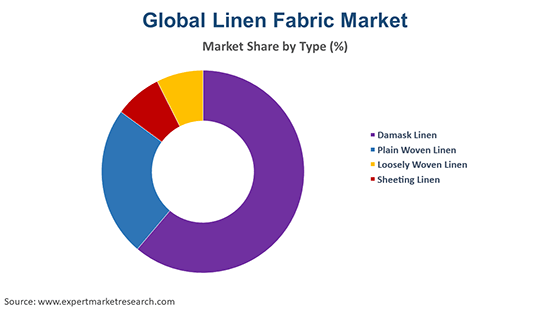
Read more about this report - REQUEST FREE SAMPLE COPY IN PDF
The EMR’s report titled “Global Linen Fabric Market Report and Forecast 2026-2035” offers a detailed analysis of the market based on the following segments:
Market Breakup by Type
Key Insight: Damask linen holds the leading position in the global industry due to its sophistication and multipurpose appeal. Damask linen’s resurgence is particularly notable in heritage restoration projects and upscale restaurants. European hotel groups are shifting back from polyester blends to damask for its eco-luxury positioning. Textile mills in France and Portugal have started offering digital jacquard looms, allowing clients to customise patterns in short runs.
Market Breakup by Application
Key Insight: Apparel remains dominant in the linen fabric market industry, especially as carbon-conscious consumers and brands pivot from synthetics. The growth in B2B demand is also accelerated by customisation technology as platforms now let brands configure stitching, shades, and shrinkage rates. Italian and Lithuanian mills have begun offering waterless dyeing services, giving buyers ESG-friendly supply options. This intersection of fashion, functionality, and environmental stewardship supports apparel as the strongest application in the market.
Breakup by Region
Key Insight: Europe's dominance in the global market has become unparalleled due to the region’s vertically integrated, sustainable supply chain. From field to fabric, the region offers unmatched traceability. B2B buyers benefit from real-time quality audits, regional logistics hubs, and green shipping policies. German hospitals and Danish schools now mandate natural-fibre textiles, and French hotel chains prioritize GOTS-certified suppliers. Governments have also subsidised next-gen flax breeding programs to reduce chemical inputs, which feeds into linen production.
By Type, Damask Linen Secure the Dominant Position in the Market
Damask linen dominates the global market due to its high-end appeal in hospitality and décor. Its complex patterns, achieved through jacquard weaving, cater to luxury tablecloths and upholstery markets. For instance, the United States imports a significant volume of damask linen, primarily for commercial dining venues and boutique hotels. Italian mills, such as Tessitura Toscana Telerie, are innovating with damask blends using bamboo and linen, offering softness without sacrificing durability. These blends are gaining traction among premium restaurants and wedding décor suppliers. Furthermore, regional governments in Italy and Spain have rolled out digital textile funding programmes that support such innovations, thereby boosting the linen fabric market expansion.
The demand for plain woven linen fabric is particularly driven by fast fashion and private label clothing lines. Its basic crisscross weave makes it ideal for mass production and dyeing. According to India’s Ministry of Textiles, textile exports grew 8.21% in FY 2023-24, mainly to the United Arab Emirates and the United Kingdom. With low shrinkage rates and cost-effectiveness, it is being increasingly favoured by eco-fashion brands. The growth of budget apparel startups, supported by Make in India’s Production-Linked Incentive (PLI) scheme, is driving domestic manufacturing of this subsegment.
By Application, Apparel Registers the Majority of the Market Share
Apparel clocks in the leading position as the primary application area, driven by rising demand for breathable summer wear and sustainable fashion lines. Over 60 international brands, including H&M and Mango, introduced linen capsules. European startups like Son of a Tailor offer made-to-measure linen shirts using AI-powered fitting models. In Japan, local brands are tapping into demand for light office outfits, pushing government grants toward sustainable apparel startups. B2B buyers in workwear and boutique fashion are increasingly turning to certified linen suppliers for both low-volume exclusive products and high-volume seasonal rollouts.
Bedsheets and bedding linen are growing rapidly boosting the linen fabric market revenue due to rising disposable incomes and health-conscious sleeping habits. The growth of this application category is accelerated by the rising demand for eco-home collections. Textile brands are now embedding aroma capsules and cooling finishes into bedding linen. B2B hospitality and homestay sectors, particularly across Southeast Asia and Europe, are increasingly shifting procurement toward linen bedding for its hypoallergenic and breathable properties.
| CAGR 2026-2035 - Market by | Country |
| India | 3.5% |
| China | 3.3% |
| Canada | 3.1% |
| Australia | 2.9% |
| UK | 2.8% |
| USA | XX% |
| Germany | XX% |
| France | XX% |
| Japan | 2.8% |
| Saudi Arabia | XX% |
| Brazil | XX% |
| Mexico | XX% |
| Italy | 2.6% |
By Region, Europe Accounts for the Largest Share of the Industry
Europe currently holds the dominant share of the global industry due to the region’s historical expertise and government-led sustainability frameworks. The EU’s Strategy for Sustainable and Circular Textiles emphasises natural fibre use, boosting regional flax and linen integration. France, Belgium, and Italy jointly supply over 75% of global flax, and their mills maintain high-tech, low-impact production lines. B2B linen sourcing is centred around traceability, with blockchain-tracked batches becoming standard.
Asia Pacific registers the fastest CAGR boosting the linen fabric demand growth. The region’s growth is led by India, China, and Bangladesh. India’s linen exports rose by 6.32% in 2024, supported by the PM MITRA textile park initiative. China has invested in smart looms and AI-integrated dye houses to automate linen production at scale. Meanwhile, Australia is witnessing local flax cultivation trials under its Ag2030 roadmap to reduce reliance on imports. Furthermore, digital marketplaces like IndiaMART are accelerating B2B sourcing, especially among small apparel brands and hospitality chains.
Global linen fabric market players have mainly focused on eco-certifications and supply chain transparency. Linen mills are launching B2B-exclusive digital catalogues and offering white-label design services to small fashion brands. There is also a growing demand for antimicrobial finishes, smart linen for interiors, and enzyme-washed options for apparel. Linen fabric companies are shifting toward regional warehousing to cater to just-in-time B2B buyers and exploring partnerships with biotech firms for fabric innovation. With sustainability mandates becoming universal, market players focusing on carbon neutrality, regenerative flax farming, and waterless processing are expected to dominate upcoming procurement cycles. Many players are also adopting blockchain technology for traceability and integrating AI-driven demand forecasting tools to reduce inventory waste. There is also a notable push for creating high-performance linen composites for automotive interiors and premium upholstery.
Established in 1994, headquartered in California, United States, World Linen & Textile Company In is a pioneer in supplying linen to institutional clients like hotels and universities. The company largely focuses on fast delivery and premium custom orders.
Founded in 1947 and based in Mumbai, Grasim is diversifying into linen with advanced spinning facilities. Their R&D focuses on organic blends and digitally printed linen fabrics for large-format fashion retailers.
Headquartered in China since 2003, China Linen Textile Industry Ltd is a vertically integrated firm that controls the entire flax-to-fabric pipeline. The company is known for precision-engineered linen for uniforms, exporting to over 20 countries.
Based in New York, United States, since 1967, Ralph Lauren sources European linen for its heritage home collection. The company’s B2B division caters to luxury interior designers and high-end hospitality firms globally.
*Please note that this is only a partial list; the complete list of key players is available in the full report. Additionally, the list of key players can be customized to better suit your needs.*
Other key players in the market are Flax Company SARL, Northern Linen BV, and Libeco NV, among others.
Explore the latest trends shaping the global linen fabric market 2026-2035 with our in-depth report. Gain strategic insights, future forecasts, and key market developments that can help you stay competitive. Download a free sample report or contact our team for customized consultation on linen fabric market trends 2026.


Upto 15% Off
USD
$2499 $2249
$3999 $3599
$4999 $4249
$5999 $5099


*While we strive to always give you current and accurate information, the numbers depicted on the website are indicative and may differ from the actual numbers in the main report. At Expert Market Research, we aim to bring you the latest insights and trends in the market. Using our analyses and forecasts, stakeholders can understand the market dynamics, navigate challenges, and capitalize on opportunities to make data-driven strategic decisions.*
Get in touch with us for a customized solution tailored to your unique requirements and save upto 35%!
In 2025, the market attained a volume of nearly 985.38 KMT.
The market is projected to grow at a CAGR of 3.00% between 2026 and 2035.
The market is estimated to witness a healthy growth in the forecast period of 2026-2035 to reach about 1324.27 KMT by 2035.
The key trends guiding the market growth include the growing popularity of linen fabric in developing countries and the rising use of linen fabric in home décor applications.
The major regions in the market are North America, Europe, the Asia Pacific, Latin America, and the Middle East and Africa.
The major types of linen fabric are damask linen, plain woven linen, loosely woven linen, and sheeting linen.
The several applications of linen fabric include apparel, table and kitchen clothes, towels and other bathroom items, bedsheet and other bedroom items, curtains, and blankets and cushions, among others.
The key challenges are supply chain disruption, high input costs, lack of scalable flax farming, and limited skilled labor in emerging regions.
The key players in the linen fabric market include World Linen & Textile Company Inc, Grasim Industries Limited, China Linen Textile Industry Ltd, Ralph Lauren Corporation, Flax Company SARL, Northern Linen BV, and Libeco NV, among others.
Explore our key highlights of the report and gain a concise overview of key findings, trends, and actionable insights that will empower your strategic decisions.
| REPORT FEATURES | DETAILS |
| Base Year | 2025 |
| Historical Period | 2019-2025 |
| Forecast Period | 2026-2035 |
| Scope of the Report |
Historical and Forecast Trends, Industry Drivers and Constraints, Historical and Forecast Market Analysis by Segment:
|
| Breakup by Type |
|
| Breakup by Application |
|
| Breakup by Region |
|
| Market Dynamics |
|
| Competitive Landscape |
|
| Companies Covered |
|
| Report Price and Purchase Option | Explore our purchase options that are best suited to your resources and industry needs. |
| Delivery Format | Delivered as an attached PDF and Excel through email, with an option of receiving an editable PPT, according to the purchase option. |
Datasheet
One User
USD 2,499
USD 2,249
tax inclusive*
Single User License
One User
USD 3,999
USD 3,599
tax inclusive*
Five User License
Five User
USD 4,999
USD 4,249
tax inclusive*
Corporate License
Unlimited Users
USD 5,999
USD 5,099
tax inclusive*
*Please note that the prices mentioned below are starting prices for each bundle type. Kindly contact our team for further details.*
Flash Bundle
Small Business Bundle
Growth Bundle
Enterprise Bundle
*Please note that the prices mentioned below are starting prices for each bundle type. Kindly contact our team for further details.*
Flash Bundle
Number of Reports: 3
20%
tax inclusive*
Small Business Bundle
Number of Reports: 5
25%
tax inclusive*
Growth Bundle
Number of Reports: 8
30%
tax inclusive*
Enterprise Bundle
Number of Reports: 10
35%
tax inclusive*
How To Order

Select License Type
Choose the right license for your needs and access rights.

Click on ‘Buy Now’
Add the report to your cart with one click and proceed to register.

Select Mode of Payment
Choose a payment option for a secure checkout. You will be redirected accordingly.
Gain insights to stay ahead and seize opportunities.

Get insights & trends for a competitive edge.

Track prices with detailed trend reports.

Analyse trade data for supply chain insights.

Leverage cost reports for smart savings

Enhance supply chain with partnerships.

Connect For More Information
Our expert team of analysts will offer full support and resolve any queries regarding the report, before and after the purchase.
Our expert team of analysts will offer full support and resolve any queries regarding the report, before and after the purchase.
We employ meticulous research methods, blending advanced analytics and expert insights to deliver accurate, actionable industry intelligence, staying ahead of competitors.
Our skilled analysts offer unparalleled competitive advantage with detailed insights on current and emerging markets, ensuring your strategic edge.
We offer an in-depth yet simplified presentation of industry insights and analysis to meet your specific requirements effectively.





Share