

Consumer Insights
Uncover trends and behaviors shaping consumer choices today
Procurement Insights
Optimize your sourcing strategy with key market data
Industry Stats
Stay ahead with the latest trends and market analysis.

The India sanitary napkin market was valued at USD 893.66 Million in 2025. The market is expected to grow at a CAGR of 6.30% during the forecast period of 2026-2035 to reach a value of USD 1646.28 Million by 2035. This growth is supported by increasing female participation in the workforce, improved income levels, and expanding health infrastructure.
The NFHS-5 survey conducted in 2024 showed that 77% of women aged 15-24 practice hygienic menstruation as opposed to 58% in NFHS-4. This is attributed to increasing retail expansion in Tier 2 and Tier 3 cities. Also, some new companies have come up with subscription based tailored biodegradable pads funded through angel and social impact funding. All these factors are enhancing accessibility and increasing growth in both core and niche products.
The steady growth of the India sanitary napkin market is in line with the growing concern of menstrual hygiene, urban migration, and policies facilitating subsidized sanitary products. After a four-year break, in March 2024, the government of Karnataka once again implemented the Shuchi scheme and subsidized sanitary napkins to 19 lakh adolescent girls. Along with other healthcare products, sanitary napkins serve a crucial function to women and girls of all ages, and the swift transformation of the napkin market in response to the growing demand is a positive shift.
Base Year
Historical Period
Forecast Period
The market is witnessing strong growth driven by increasing menstrual hygiene awareness, government schemes promoting sanitary products, rising female literacy, and expanding retail and e-commerce penetration, projected to boost demand.
Sustainability is reshaping the sector, with rising adoption of biodegradable and organic sanitary pads, growth in reusable alternatives, and demand for ultra-thin, comfort-oriented designs, fueling innovation and attracting eco-conscious urban consumers.
The market expansion is being driven by a competitive mix of global leaders, local startups, and subsidized public initiatives that are strengthening distribution across rural and semi-urban regions, enhancing product affordability and accessibility.
Compound Annual Growth Rate
6.3%
Value in USD Million
2026-2035
*this image is indicative*
National players like P&G and Johnson & Johnson continue to lead the India sanitary napkin market development, while private labels from retailers and regional manufacturers are increasing their footprint. In 2024, DMart launched its own low-cost pad line, targeting budget-conscious buyers. Simultaneously, startups are introducing specialized products including ultra-thin, overnight, and rash-free pads tailored for different needs. This growing variety is catering to evolving consumer preferences and is expanding the market by improving affordability and customization across different buyer segments
P&G and Johnson & Johnson are still the foremost players in the India sanitary napkin market development but private label products from retailers and regional brand manufacturers are also gaining market presence. In 2024, DMart began their own low-cost pads targeting value shoppers. Concurrently, startups are introducing unique items including ultra-thin overnight and rash-free pads for consumer choices. The increased variety from traditional and private labels for price and value is evolving consumer choice and market share through affordability and tailor-made fit across consumer buyers.
The central and state governments continue to offer subsidized sanitary pads through platforms, such as Menstrual Hygiene Scheme (MHS) and Rashtriya Kishor Swasthya Karyakram (RKSK) and free distribution schemes for schools in 2024 for government schools, the state of Uttar Pradesh additionally issued a ‘Mission Shakti,’ aiming to improve in menstrual hygiene, reaching at least 25 lakh girls (2.5 million). These governmental efforts for distribution are very critical, especially so because they are expanding distribution in more rural and semi urban areas. The increased visibility of these programs has resulted in new demand from first time users, increasing the overall sales in low-cost and mid-priced sanitary pads.
Online platforms are driving significant sales in the India sanitary napkin industry, especially for niche and customizable products. Subscription models and trial packs introduced by brands like Nua, Plush, and Pee Safe are helping increase consumer stickiness. In 2024, Nykaa and Amazon India reported a 30% year-on-year growth in sanitary care sales. Digital ads, influencer-driven content, and discreet packaging have enhanced adoption, particularly in urban centers. D2C models also allow brands to collect direct feedback and improve personalization, aiding product innovation and retention.
There is increasing consumer preference for eco-friendly, biodegradable pads made from organic cotton, bamboo, and corn starch. Brands like Saathi, Carmesi, and Azah reported expansion into retail chains across metros. This shift is being propelled by awareness campaigns on plastic waste generated by traditional pads and greater access to premium wellness products. The India sanitary napkin market is witnessing growing investment in research & development for leak-proof, chemical-free pads, targeting health-conscious urban consumers. Sustainable pads are creating a new growth avenue, particularly in Gen Z and millennial buyers.
Awareness efforts by NGOs, influencers, and schools are dismantling longstanding stigmas. In 2025, the ‘Period Positive’ campaign by UNESCO and UNICEF, conducted across Madhya Pradesh and Bihar, reached 1.2 million adolescent girls. Brands like Whisper’s #KeepGirlsInSchool initiative have amplified public discourse on period education. Greater awareness is leading to increased pad usage across socio-economic backgrounds. This behavioral shift is expected to unlock market growth in conservative and previously underpenetrated demographics.
Read more about this report - REQUEST FREE SAMPLE COPY IN PDF
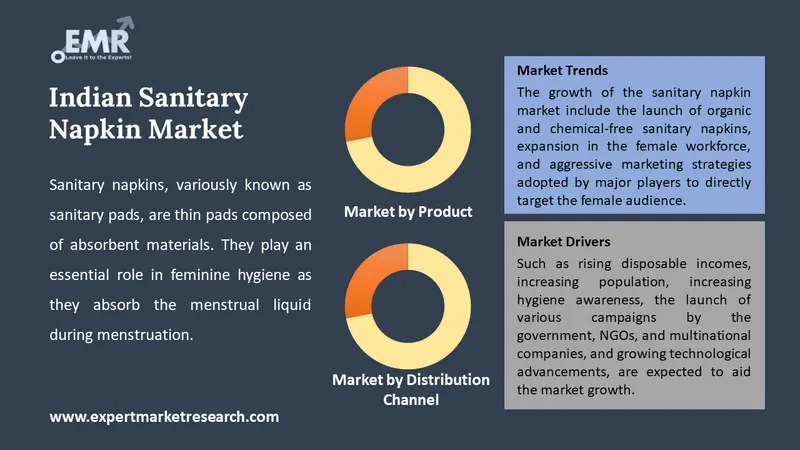
The EMR’s report titled “India Sanitary Napkin Market Report and Forecast 2026-2035” offers a detailed analysis of the market based on the following segments:
Market Breakup by Product
Key Insight: Disposable menstrual pads are the most widely used due to their convenience, affordability, and extensive availability. Large brands dominate this segment with strong distribution networks and promotional campaigns. However, biodegradable pads are gaining popularity in urban and semi-urban areas, particularly among environmentally conscious consumers. These products address the growing concern around non-biodegradable waste from traditional pads, with brands expanding their presence in metro cities and premium retail stores, adding to the India sanitary napkin industry share.
Market Breakup by Distribution Channel
Key Insight: Supermarkets and hypermarkets offer broad visibility and are ideal for mass-market disposable pads. Pharmacies and convenience stores are vital for both impulse and necessity-based purchases, especially in small towns and rural areas. Online platforms are rapidly expanding, enabling access to specialty and subscription-based brands with doorstep delivery and discreet packaging. The online segment is witnessing increased uptake in Tier 1 and Tier 2 cities due to influencer-driven awareness and targeted ads. Offline community health events and women-led kirana initiatives also support pad distribution in low-access regions.
Market Breakup by Region
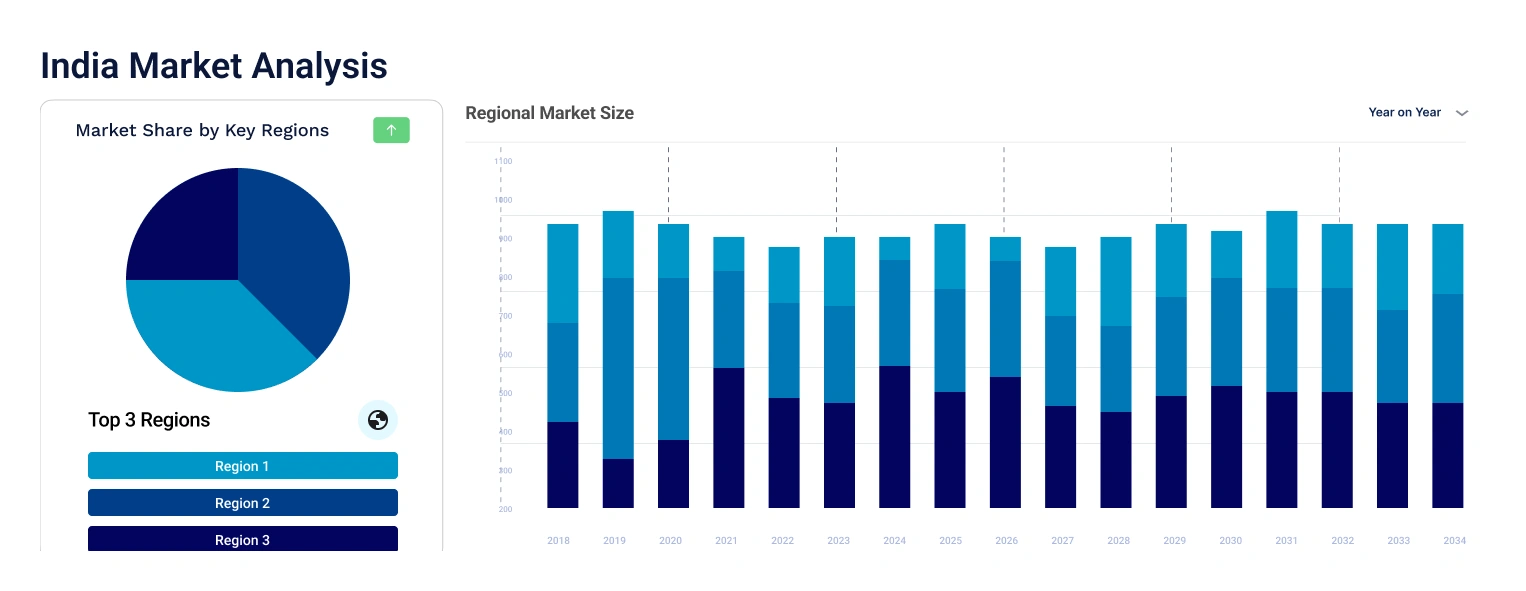
Key Insight: South India sanitary napkin market revenue is growing due to higher literacy rates, better health infrastructure, and greater awareness. States like Kerala and Tamil Nadu show mature product penetration and openness to sustainable products. North India, with states like Delhi, Haryana, and Uttar Pradesh, is also a strong market, supported by active school campaigns and NGO outreach. East and Central India remain underpenetrated but are rapidly catching up due to targeted campaigns and schemes. West India, particularly Maharashtra and Gujarat, is showing a shift toward premium and biodegradable options due to urban demand and high disposable incomes.
By product, disposable menstrual pads to retain the largest share with wide distribution channels
Disposable menstrual pads currently dominate the India sanitary napkin market due to their convenience, affordability, and wide distribution network. Leading brands have built strong consumer trust through years of marketing, availability in both urban and rural areas, and constant product innovation like ultra-thin and overnight variants. Their mass production and low unit pricing make them accessible to a large section of menstruating women, especially in Tier 1 and Tier 2 cities. Government schemes like the Shuchi and Khushi programs also rely heavily on distributing disposable pads to adolescent girls in schools and colleges.
Biodegradable menstrual pads represent a rapidly growing segment, driven by increasing environmental concerns and demand for sustainable alternatives. These products appeal primarily to eco-conscious consumers in urban areas. CSR projects and state initiatives are promoting biodegradable or reusable products in rural communities. In January 2025, CSIR-IICT partners with a private firm to convert farm waste into eco-friendly, compostable sanitary pads, promoting sustainable menstrual hygiene. Their adoption is expected to rise with growing awareness and improved access through government and NGO efforts.
Supermarkets and hypermarkets & pharmacies to capture significant share due to portfolio expansions
Supermarkets and hypermarkets are the most dominant distribution channels for the sanitary napkin market in India. Large retail chains, such as Big Bazaar, Reliance Fresh, and Spencer’s offer extensive product variety, competitive pricing, and easy accessibility. In 2024, Reliance Fresh expanded its feminine hygiene aisle by introducing eco-friendly sanitary napkins from brands like Saathi and Niine, making biodegradable options more accessible to urban and semi-urban shoppers. These stores attract urban and semi-urban shoppers who prefer one-stop shopping for their daily and hygiene needs, making them a key platform for major brands like Whisper and Stayfree to reach consumers.
Pharmacies hold a large market share, especially in semi-urban and rural areas. Trusted chains like Apollo Pharmacy and local chemists provide a convenient and reliable point of purchase. Consumers often prefer pharmacies due to the availability of recommended hygiene products and the assurance of product authenticity. Additionally, pharmacies frequently stock niche and medicated pads catering to specific needs like sensitivity or infections. During government health drives and NGO campaigns, pharmacies also play a critical role in distributing subsidized or free sanitary napkins, enhancing menstrual hygiene outreach in underserved regions.
South India claims a leading market position owing to rapid urbanization
South India sanitary napkin market is dominant owing to strong institutional support, higher hygiene awareness, and better infrastructure. States like Tamil Nadu and Kerala have longstanding school-based menstrual health programs. In 2024, Tamil Nadu expanded its free pad distribution scheme to over 14,000 schools. Urban centers such as Bengaluru and Hyderabad have also witnessed growing demand for premium and biodegradable sanitary products, driven by tech-savvy and health-conscious populations.
North India, particularly Delhi NCR, Haryana, and parts of Uttar Pradesh, is emerging as a high-demand zone. Rising health awareness, government outreach programs like Mission Shakti, and increased urbanization are encouraging usage. West India is seeing traction in premium pads and D2C brands, especially in metros like Mumbai and Pune. East and Central India, while traditionally underserved, have shown improvement with NGO-led outreach in Bihar, Jharkhand, and Chhattisgarh. These regions are expected to grow rapidly as access to education, digital platforms, and low-cost menstrual products expands.
The India sanitary napkin industry is competitive with multinational companies, local startups, and NGO-sponsored projects dominating the segment. P&G's Whisper and Johnson & Johnson's Stayfree remain leaders with strong distribution and brand value. Yet the market has transformed as socially responsible and environmentally friendly brands have entered for niche consumer segments. These players provide differentiated products like herbal, biodegradable, and organic pads with a premium pricing strategy.
Startups are using digital marketing and subscription platforms to create communities and drive engagement. Online sales and category growth were reported by brands, such as Nua, Carmesi, and Pee Safe. Regional and private-label brands, however, are competing on price points, penetrating underserved segments through offline health drives and pharmacy networks. Bio-based material research & development and strategic manufacturing alliances are on the rise. Certain companies are also putting money into rural awareness campaigns under their CSR efforts to establish brand presence. Pricing, sustainability, comfort, and access continue to be important areas of competition.
Established in 1837, Procter & Gamble has its headquarters in Cincinnati, the United States. Its iconic sanitary napkin brand Whisper made a mark in India's market by introducing novel features such as the "ultra-thin" pad and odor controlling technology. The brand has constantly driven awareness campaigns to enhance menstrual hygiene in the nation.
Johnson & Johnson, headquartered in New Jersey, the United States, since its founding in 1886, introduced Stayfree as a reliable Indian feminine hygiene brand. With its leak-proof, comforting pads, Stayfree has introduced breathable material and antimicrobial technology, further consolidating its lead among Indian consumers.
Unicharm, established in 1961 in Tokyo, Japan, owns Sofy in India. Sofy is known for its high-tech absorbency system and ergonomic products designed to meet the needs of various consumers. Its innovative marketing and product excellence have contributed to the growth of its presence in urban and rural areas.
Incorporated in 2016 and based in Bangalore, India, Carmesi specializes in chemical-free and environmentally friendly menstrual products. Its innovations range from reusable cloth pads to biodegradable disposables, targeting environmentally conscious and health-focused consumers, and advocating for menstrual education through community outreach programs.
*Please note that this is only a partial list; the complete list of key players is available in the full report. Additionally, the list of key players can be customized to better suit your needs.*
Other key players in the India sanitary napkin market are Nua, Saathi Pads, Azah, Pee Safe, Heyday and Niine Hygiene and Personal Care.
Download your free sample of the India sanitary napkin market report to explore the latest market trends, growth drivers, and competitive landscape shaping 2026 and beyond. Stay ahead with expert insights on product innovations, distribution strategies, and consumer behavior in this evolving market.


Upto 15% Off
USD
$1999 $1799
$3099 $2789
$4599 $3909
$5999 $5099


*While we strive to always give you current and accurate information, the numbers depicted on the website are indicative and may differ from the actual numbers in the main report. At Expert Market Research, we aim to bring you the latest insights and trends in the market. Using our analyses and forecasts, stakeholders can understand the market dynamics, navigate challenges, and capitalize on opportunities to make data-driven strategic decisions.*
Get in touch with us for a customized solution tailored to your unique requirements and save upto 35%!
In 2025, the market reached an approximate value of USD 893.66 Million.
The market is projected to grow at a CAGR of 6.30% between 2026 and 2035.
The key players in the market include Procter & Gamble (Whisper), Johnson & Johnson (Stayfree), Unicharm India Pvt. Ltd. (Sofy), Carmesi, Nua, Saathi Pads, Azah, Pee Safe, Heyday and Niine Hygiene and Personal Care.
Core strategies include raising awareness about menstrual hygiene, increasing access to affordably priced products, promoting options that are biodegradable and reusable, using government and non-government organization initiatives, improving access through e-commerce and brick-and-mortar stores, and educating and marketing to urban and rural residents.
Some of the main challenges include high product costs which limit access, cultural stigma around menstruation, lack of awareness in rural areas, access to distribution, the prevalence of competition from traditional products that are low-cost, and negative environmental implications of plastic used in disposable pads pose challenges to large-scale uptake of more sustainable options.
Explore our key highlights of the report and gain a concise overview of key findings, trends, and actionable insights that will empower your strategic decisions.
| REPORT FEATURES | DETAILS |
| Base Year | 2025 |
| Historical Period | 2019-2025 |
| Forecast Period | 2026-2035 |
| Scope of the Report |
Historical and Forecast Trends, Industry Drivers and Constraints, Historical and Forecast Market Analysis by Segment:
|
| Breakup by Type |
|
| Breakup by Product |
|
| Breakup by Distribution Channels |
|
| Breakup by Region |
|
| Market Dynamics |
|
| Supplier Landscape |
|
| Companies Covered |
|
Datasheet
One User
USD 1,999
USD 1,799
tax inclusive*
Single User License
One User
USD 3,099
USD 2,789
tax inclusive*
Five User License
Five User
USD 4,599
USD 3,909
tax inclusive*
Corporate License
Unlimited Users
USD 5,999
USD 5,099
tax inclusive*
*Please note that the prices mentioned below are starting prices for each bundle type. Kindly contact our team for further details.*
Flash Bundle
Small Business Bundle
Growth Bundle
Enterprise Bundle
*Please note that the prices mentioned below are starting prices for each bundle type. Kindly contact our team for further details.*
Flash Bundle
Number of Reports: 3
20%
tax inclusive*
Small Business Bundle
Number of Reports: 5
25%
tax inclusive*
Growth Bundle
Number of Reports: 8
30%
tax inclusive*
Enterprise Bundle
Number of Reports: 10
35%
tax inclusive*
How To Order

Select License Type
Choose the right license for your needs and access rights.

Click on ‘Buy Now’
Add the report to your cart with one click and proceed to register.

Select Mode of Payment
Choose a payment option for a secure checkout. You will be redirected accordingly.
Gain insights to stay ahead and seize opportunities.

Get insights & trends for a competitive edge.

Track prices with detailed trend reports.

Analyse trade data for supply chain insights.

Leverage cost reports for smart savings

Enhance supply chain with partnerships.

Connect For More Information
Our expert team of analysts will offer full support and resolve any queries regarding the report, before and after the purchase.
Our expert team of analysts will offer full support and resolve any queries regarding the report, before and after the purchase.
We employ meticulous research methods, blending advanced analytics and expert insights to deliver accurate, actionable industry intelligence, staying ahead of competitors.
Our skilled analysts offer unparalleled competitive advantage with detailed insights on current and emerging markets, ensuring your strategic edge.
We offer an in-depth yet simplified presentation of industry insights and analysis to meet your specific requirements effectively.





Share