

Consumer Insights
Uncover trends and behaviors shaping consumer choices today
Procurement Insights
Optimize your sourcing strategy with key market data
Industry Stats
Stay ahead with the latest trends and market analysis.

The India farm agri equipment market attained a value of USD 1248.26 Billion in 2025 and is projected to expand at a CAGR of 10.40% through 2035. The market is further expected to achieve USD 3357.34 Billion by 2035. Rising demand for crop residue handling and hay compression services across dairy-intensive belts is accelerating adoption of balers and rakes, creating a new revenue stream in the market.
A major shift in the market became clear in August 2023, when Mahindra & Mahindra commercially launched its OJA connected tractor platform, built on lightweight global architecture with automated implement control and near real-time field performance monitoring. For fleet owners and large farmer producer organizations (FPOs), lower fuel burn and greater predictability of per-acre cost is translating directly into faster ROI, accelerating the India farm agri equipment market growth.
Demand patterns in the market are also shaped by mechanization programs across horticulture, cereals, and fodder chains, plus the steady transition from owned tractors to pay-per-acre farm machinery rental. Farmers are prioritizing machines that deliver multi-crop flexibility, tractors with smart implements, balers with moisture sensors, and precision planters with variable seed metering. For instance, in October 2025, Gromax Agri Equipment Ltd. a joint venture between Mahindra & Mahindra Ltd. and the Government of Gujarat launched of 8 new tractors in the 4WD and 2WD categories, including India’s first factory-fitted cabin series in the under the 50 HP category.
Companies like VST Tillers, TAFE, and CNH Industrial are responding with electric-ready drive trains, CAN-enabled implements, and remote diagnostics that reduce breakdown risk during peak harvest cycles, further redefining the India farm agri equipment market trends and dynamics. Dealers who can offer uptime commitments and shared equipment pools are also becoming more valuable.
Base Year
Historical Period
Forecast Period
Compound Annual Growth Rate
10.4%
Value in USD Billion
2026-2035
*this image is indicative*
Government-backed mechanization continues to be one of the strongest catalysts driving demand in the India farm agri equipment market. The Sub Mission on Agricultural Mechanization offers subsidies up to 50-80%, on implements and power equipment. States like Uttar Pradesh and Maharashtra add top up support for tractors, residue-management machines, and even agri drones. Meanwhile, the Union agriculture budget crossed INR 122500 crore in 2024–25, signaling long term intent. In November 2025, Mahindra & Mahindra announced the launch of its new Groundnut Thresher. The machine is designed to be tractor-powered and enables accurate threshing by separating groundnuts from their pods.
The growth of custom hiring centers and farm machinery rental platforms is reshaping how equipment reaches farmers. Under national mechanization guidelines, cooperatives, FPOs and rural entrepreneurs receive support to set up custom hiring centers and high-tech hubs, giving farmers pay per use access instead of full ownership. On the other hand, Tractors and Farm Equipment (TAFE) offers ‘JFarm Services’ and the ‘JFarm Services App’, which brings the benefits of the technology-enabled sharing economy to boost the income of the country’s farmers through agriculture. At the same time, private players like EM3 and Mahindra’s Trringo model offer Uber style booking of tractors and implements, redefining the India farm agri equipment market dynamics. This ecosystem lets OEMs sell larger fleets while farmers buy only hours of machine time over mobile phones with simple interfaces.
Another important growth factor is the push toward smallholder-friendly equipment that fits fragmented landholdings. Programs like the Assistance to Farmers for Mini Tractor and Power Tiller scheme in Tamil Nadu offer horsepower-based subsidies on compact models, making sub-30 HP tractors far more affordable and accessible to smallholders. Companies like KisanKraft are scaling low-cost power weeders, reapers, and sprayers designed specifically for Indian plots, and now plan expansion into over fifty countries, broadening the India farm agri equipment market expansion. For example, in October 2025, AgVaya launched Global AgXelerate to connect agricultural innovators with global markets, capital investments, and technology ecosystems across countries.
New tractor platforms, including Mahindra’s OJA series, ship with telematics ready architectures that log fuel use, slip and implement performance per acre. State departments are also experimenting with GPS tracking of crop residue management machines to verify utilization and curb stubble burning. This data-centric trend gives OEMs a chance to sell dashboards, predictive maintenance, and fleet optimization services, accelerating demand in the India farm agri equipment market. In March 2023, Cranot Technologies launched Krish-e Smart Kit a smart device that provides equipment owners with detailed insights of their tractors and farm equipment, through GPS enabled time tracking and remote monitoring of various parameters from the comfort of a smart phone.
Sustainability pressure is also nudging industry players to innovate their product lines. Central schemes promote crop residue management machines like seeders and mulchers to curb stubble burning, backed by high subsidies for individuals and groups. In September 2025, Mahindra Farm Equipment Business launched the Mahindra AIROTEC Turbo 600 Alpha Sprayer for orchard crops, impacting the overall growth in the India farm agri equipment market. Parallel policy discussions now look at including electric tractors under future FAME style incentive frameworks, which could offset higher upfront prices and support local manufacturing. OEMs experiment with hybrid and battery platforms on smaller horsepower ranges first. Over time, cleaner implements and tractors should align farm machinery with broader climate and air quality commitments in the country.
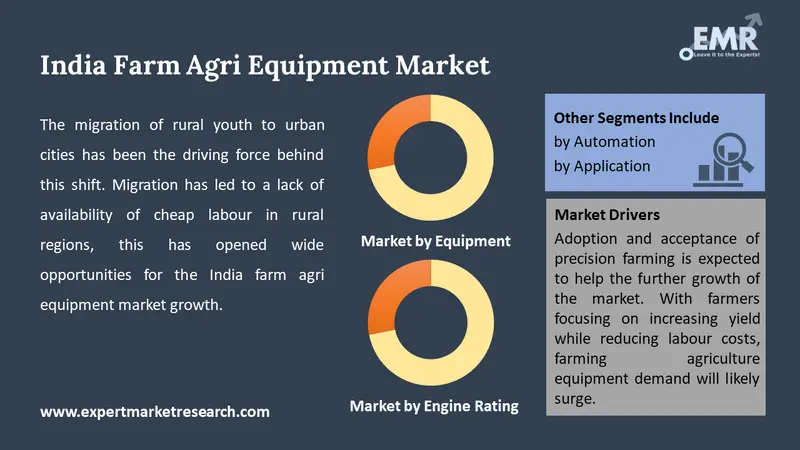
Read more about this report - REQUEST FREE SAMPLE COPY IN PDF
The EMR’s report titled “India Farm Agri Equipment Market Report and Forecast 2026-2035” offers a detailed analysis of the market based on the following segments:
Market Breakup by Equipment
Key Insight: Tractor and power tiller driven tools remain dominant in the India farm agri equipment market dynamics because they cover multiple jobs across seasons. Dedicated sowing, planting, reaping, and digging implements sharpen performance and support higher value crops. Harvesting and threshing machinery reduces risk during unseasonal rain. Rice transplanters and other specialized units target waterlogged, time sensitive operations. Self-propelled machines have become common in high income belts.
Market Breakup by Engine Rating
Key Insight: Engine rating choices are mostly based on cropping patterns, soil conditions, and financing depth. Up to 30 HP units attract first time buyers and intensive horticulture users that need agility. The 31–60 HP category supports broad acre crops and mixed farming systems, and hence, it continues as the dominant engine rating. Higher horsepower machines serve sugarcane, heavy haulage, and laser levelling tasks where draft loads are tougher, thereby driving demand in the India farm agri equipment market.
Market Breakup by Automation
Key Insight: As per the India farm agri equipment market report, manual tools continue to stay relevant in marginal fields and short distance tasks. Semi-automatic machines, ranging from simple hydraulic implements to assisted transmissions, have gained major popularity among users. Fully automatic and sensor-rich platforms are emerging at the top end wherever labor is short, crop value is high, and service networks already exist. As digital literacy improves, more farmers will be willing to trust embedded intelligence with routine control decisions across operations.
Market Breakup by Application
Key Insight: Land development and seed bed preparation need robust tillage and levelling tools that can handle tight windows before sowing. Sowing and planting operations lean on precision implements that protect seeds and fertilizer spend. Weed cultivation combines manual and mechanized tactics depending on crop and region, thereby boosting the India farm agri equipment market penetration. Harvesting and threshing require reliable machines that can adapt quickly when weather turns unpredictable. Post harvest and agro processing steps link farm work to markets, encouraging more investment in cleaning, grading, and storage tools.
Market Breakup by Region
Key Insight: Regional dynamics in the India farm agri equipment market are mostly shaped by water accessibility, crop availability, and policy design. The Northern region leans on larger tractors and intensive mechanization tied to procurement crops. The Southern region experiences growth through compact machines, plantation tools, and specialized implements for horticulture. Western states combine cotton, oilseeds, and high value fruit, demanding broad equipment categories. The Eastern region is growing at a much slower pace yet shows rising interest in power tillers, rice transplanters, and small harvesters as labor costs become steeper.
By equipment, tractor and power tiller driven equipment dominate the market as they enable multipurpose tasks
Tractor and power tiller driven equipment hold the dominant share in the India farm agri equipment market because they form the core of most mechanized operations. A single tractor platform can pull cultivators, rotavators, seed drills, sprayers, and trailers across seasons, so farmers see it as the first big technology upgrade. Power tillers extend similar benefits in smaller plots where turning radius and field access are tight. OEMs focus on adding multi speed PTOs, hydraulic remotes, and quick hitch systems that let the same chassis run more implements per year.
The sowing, planting, reaping, and digging equipment category is observing consistent growth in the India farm agri equipment market as farmers try to complete more fieldwork within increasingly tight weather windows. Precision planters, bed makers, and pneumatic seed drills help improve spacing, depth control, and seed use, which matters when input prices keep rising.
By engine rating, mid-range 31-60 HP tractors dominate the market by balancing cost and versatility
Tractors in the 31–60 HP band dominate the market dynamics because they balance power, price, and versatility for most field conditions. This range can handle primary tillage, seeding, spraying, and haulage without feeling over or under specified in mixed cropping belts. Banks and NBFCs also prefer financing this bracket, since resale values are stronger, and demand stays consistent. In March 2024, Sonalika Tractors widening its heavy-duty tractor range in India, introduced its latest ‘Sikander DLX DI 60 Torque Plus multi-speed tractor’, thereby propelling the India farm agri equipment market revenue growth.
Up to 30 HP machines are the fastest growing engine rating segment as smallholders and horticulture growers look for compact yet capable tractors and power tillers. These units move easily on narrow village roads and small field bunds, making them practical for fragmented landholdings and leased plots. Subsidy schemes in several states explicitly target mini tractors and power tillers, which improves affordability.
Semi-automatic secures the largest share of the market matching smallholder skills and budget constraints
Semi-automatic equipment dominates the overall India farm agri equipment market growth, matching current labor patterns and skill levels without demanding full sensor-based control. Operators still manage steering, depth, and timing, while gearboxes, clutches, or simple hydraulic linkages reduce effort. This style of mechanization gives farmers a sense of control over the job, while increasing their productivity levels. In May 2025, Researchers at IIT Kharagpur developed a semi-automatic tracked agricultural robot, a ‘FarmBot’, designed to operate on India's uneven farm terrain. Manufacturers find it easier to keep prices accessible and electronics minimal in this band, which improves reliability in dusty, hot environments.
Fully automatic equipment is the fastest growing automation category, although from a smaller base, as larger farms and progressive FPOs look for precision and labor savings, creating new India farm agri equipment market opportunities. This includes auto depth control planters, robotic rice transplanters, and combines yield mapping features. These machines rely on sensors, ECUs, and sometimes GPS guidance to keep operations consistent even when driver skills vary.
By application, land development and seedbed preparation secure a substantial share of the market, driving demand for implements
Land development and seed bed preparation dominate the application category of the market. This is because almost every crop cycle begins with soil conditioning and levelling. Tractors paired with disc harrows, rotavators, ploughs, and laser levelers account for a large share of early season hours. Farmers see visible impact when fields are leveled and clod free, so they prioritize this stage when deploying machines. Good seed beds reduce waterlogging, improve germination, and make later operations smoother.
Post harvest and agro processing applications are growing fastest as farmers and FPOs look beyond field work into cleaning, grading, and value addition, stimulating the India farm agri equipment market value. Simple shellers, graders, dryers, and small milling units help capture better prices and reduce losses during storage. Government schemes and private players are pushing mini processing clusters near production zones, which creates demand for integrated equipment lines.
The northern region captures major demand, supported by irrigation and procurement incentives
The Northern region dominates the overall farm agri equipment demand in India because of higher irrigation coverage, strong procurement support, and a long-standing culture of tractor ownership. States like Punjab, Haryana, and western Uttar Pradesh run multiple crop cycles, which lifts machine hours per year. Custom hiring centers and contractor fleets are common, so new models get adopted faster in busy areas.
The Southern India farm agri equipment industry is currently growing at an accelerated pace as diversified cropping, plantations, and horticulture drive need for tailored machines. States like Karnataka, Tamil Nadu, Andhra Pradesh, and Telangana show strong potential for power tillers, mini tractors, and specialized implements for orchards and vegetables. Rainfed belts look for lighter equipment that can handle mixed soils and scattered plots. Coastal areas and plantation districts demand terrain-friendly tractor models.
Read more about this report - REQUEST FREE SAMPLE COPY IN PDF
The market landscape seems to be quite competitive and crowded, yet strategy oriented as companies are increasingly focusing on lifecycle value and data visibility. Prominent India farm agri equipment market players are building connected tractor platforms, telematics ready implements and dealer service packages that guarantee uptime during narrow sowing and harvesting windows.
At the same time, there is clear opportunity for India farm agri equipment companies who offer compact equipment tailored for horticulture, women farmers and hilly terrain where traditional tractors struggle. Rental entrepreneurs, FPOs, and cooperatives have now become serious customer groups rather than side channels, and companies that support them with fleet management, financing, and operator training tend to build long-term relationships.
Escorts Kubota Ltd, established in the year 1944, with its head office located in Faridabad, India, focuses on tractors, harvesters and construction equipment tuned for the country’s soil conditions. The company is developing premium, fuel-efficient tractor platforms and integrated precision implements while leaning on its strong dealer footprint in northern and central India.
Mahindra and Mahindra Ltd, founded in 1945 and headquartered in Punjab, India, is the country’s largest tractor maker by volume with a growing global footprint. The company is moving from metal centric selling to connected farm platforms through offerings like smart tractor ranges, rental ecosystems and agronomy advisory apps.
Tractor and Farm Equipment Ltd, established in 1960 and headquartered in Chennai, India, builds Massey Ferguson and TAFE branded tractors for India and export markets. The company concentrates on robust mid horsepower platforms, precision seed and tillage implements and close partnerships with rural financiers.
VST Tillers and Tractors Ltd, formed in 1967 and headquartered in Japan, specializes in power tillers, compact tractors and niche implements. The company, operating from Bengaluru in India, focuses on smallholder and horticulture intensive regions where narrow fields and orchards demand agile machines. It tailors low weight, fuel efficient models that can navigate tight village roads and terraced farms.
*Please note that this is only a partial list; the complete list of key players is available in the full report. Additionally, the list of key players can be customized to better suit your needs.*
Other key players in the market include John Deere India Private Ltd, Greaves Cotton Ltd, Tirth Agro Technology Private Limited, Landforce Group, Khedut Agro, and Action Construction Equipment Ltd, among others.
Unlock the latest insights with our India farm agri equipment market trends 2026 report. Discover regional growth patterns, consumer preferences, and key industry players. Stay ahead of competition with trusted data and expert analysis. Download your free sample report today and drive informed decisions in the market.


Upto 15% Off
USD
$2999 $2699
$4399 $3959
$5599 $4759
$6659 $5660


*While we strive to always give you current and accurate information, the numbers depicted on the website are indicative and may differ from the actual numbers in the main report. At Expert Market Research, we aim to bring you the latest insights and trends in the market. Using our analyses and forecasts, stakeholders can understand the market dynamics, navigate challenges, and capitalize on opportunities to make data-driven strategic decisions.*
Get in touch with us for a customized solution tailored to your unique requirements and save upto 35%!
In 2025, the market reached an approximate value of USD 1248.26 Billion.
The market is projected to grow at a CAGR of 10.40% between 2026 and 2035.
Key strategies driving the market include expanding rental fleets, co-designing implements with FPOs, investing in telematics and diagnostics, deepening dealer training, and aligning finance schemes with cropping calendars to make upgrades smoother for customers.
The key trends of the market are increasing adoption owing to better yield and decline in the use of human resources and animals.
The regional markets for farm agri equipment are Northern Region, Southern Region, Western Region, And Eastern Region.
The significant equipment in the India farm agri equipment market are self-propelled machinery, sowing, planting, reaping, and digging equipment, harvesting and threshing equipment, tractor/power tiller driven equipment, and rice transplanter, among others.
The most common farm agri equipment is tractor.
On the basis of engine rating, market can be segregated into up to 30 HP, 31-60 HP, and 61-250 HP, among others.
The automations in the farm agri equipment market in India are fully automatic, semi-automatic, and manual.
The key players in the market include Escorts Kubota Ltd, Mahindra & Mahindra Ltd, Tractor and Farm Equipment Ltd, VST Tillers and Tractors Ltd, John Deere India Private Ltd, Greaves Cotton Ltd, Tirth Agro Technology Private Limited, Landforce Group, Khedut Agro, and Action Construction Equipment Ltd, among others.
Companies struggle with cyclical rural incomes, fragmented landholdings, dealer viability in low density regions, technology shifts, and the need to fund digital platforms while keeping tractor prices affordable for farmers.
Explore our key highlights of the report and gain a concise overview of key findings, trends, and actionable insights that will empower your strategic decisions.
| REPORT FEATURES | DETAILS |
| Base Year | 2025 |
| Historical Period | 2019-2025 |
| Forecast Period | 2026-2035 |
| Scope of the Report |
Historical and Forecast Trends, Industry Drivers and Constraints, Historical and Forecast Market Analysis by Segment:
|
| Breakup by Equipment |
|
| Breakup by Engine Rating |
|
| Breakup by Automation |
|
| Breakup by Application |
|
| Breakup by Region |
|
| Market Dynamics |
|
| Competitive Landscape |
|
| Companies Covered |
|
Datasheet
One User
USD 2,999
USD 2,699
tax inclusive*
Single User License
One User
USD 4,399
USD 3,959
tax inclusive*
Five User License
Five User
USD 5,599
USD 4,759
tax inclusive*
Corporate License
Unlimited Users
USD 6,659
USD 5,660
tax inclusive*
*Please note that the prices mentioned below are starting prices for each bundle type. Kindly contact our team for further details.*
Flash Bundle
Small Business Bundle
Growth Bundle
Enterprise Bundle
*Please note that the prices mentioned below are starting prices for each bundle type. Kindly contact our team for further details.*
Flash Bundle
Number of Reports: 3
20%
tax inclusive*
Small Business Bundle
Number of Reports: 5
25%
tax inclusive*
Growth Bundle
Number of Reports: 8
30%
tax inclusive*
Enterprise Bundle
Number of Reports: 10
35%
tax inclusive*
How To Order

Select License Type
Choose the right license for your needs and access rights.

Click on ‘Buy Now’
Add the report to your cart with one click and proceed to register.

Select Mode of Payment
Choose a payment option for a secure checkout. You will be redirected accordingly.
Gain insights to stay ahead and seize opportunities.

Get insights & trends for a competitive edge.

Track prices with detailed trend reports.

Analyse trade data for supply chain insights.

Leverage cost reports for smart savings

Enhance supply chain with partnerships.

Connect For More Information
Our expert team of analysts will offer full support and resolve any queries regarding the report, before and after the purchase.
Our expert team of analysts will offer full support and resolve any queries regarding the report, before and after the purchase.
We employ meticulous research methods, blending advanced analytics and expert insights to deliver accurate, actionable industry intelligence, staying ahead of competitors.
Our skilled analysts offer unparalleled competitive advantage with detailed insights on current and emerging markets, ensuring your strategic edge.
We offer an in-depth yet simplified presentation of industry insights and analysis to meet your specific requirements effectively.





Share