

Consumer Insights
Uncover trends and behaviors shaping consumer choices today
Procurement Insights
Optimize your sourcing strategy with key market data
Industry Stats
Stay ahead with the latest trends and market analysis.

The chatbot market size reached a value of USD 1048.32 Million in 2025. The market is expected to grow at a CAGR of 24.90% during the forecast period of 2026-2035. By 2035, the market is expected to reach USD 9685.42 Million.
The chatbot market revenue is expanding with businesses increasingly recognizing the importance of providing round-the-clock customer service. Chatbots meet this demand by offering instant, consistent responses without breaks or delays. With global customers operating in different time zones, companies leverage chatbots to ensure uninterrupted support. In May 2025, French AI startup Mistral AI launched Le Chat Enterprise, a corporate-focused chatbot designed for deep integration with enterprise content systems and offer scalable solution for global businesses. Such launches improve customer satisfaction, reduces churn, and allows human agents to focus on complex issues.
The chatbot industry is revolutionizing e-commerce via conversational interfaces that guide users from product discovery to purchase. Consumers increasingly prefer real-time conversations over static websites, particularly on mobile. Brands use chatbots to simulate the in-store assistant experience, reducing cart abandonment and increasing sales. In June 2025, Walmart launched its new generative AI shopping chatbot Sparky to help users find, plan, compare, and repurchase products effortlessly. As digital transactions rise and mobile commerce dominates, the need for interactive, conversational sales channels propels the market forward.
Base Year
Historical Period
Forecast Period
Compound Annual Growth Rate
24.9%
Value in USD Million
2026-2035
*this image is indicative*
Read more about this report - REQUEST FREE SAMPLE COPY IN PDF
| Global Chatbot Market Report Summary | Description | Value |
| Base Year | USD Million | 2025 |
| Historical Period | USD Million | 2019-2025 |
| Forecast Period | USD Million | 2026-2035 |
| Market Size 2025 | USD Million | 1048.32 |
| Market Size 2035 | USD Million | 9685.42 |
| CAGR 2019-2025 | Percentage | XX% |
| CAGR 2026-2035 | Percentage | 24.90% |
| CAGR 2026-2035 - Market by Region | Asia Pacific | 28.7% |
| CAGR 2026-2035 - Market by Country | India | 32.9% |
| CAGR 2026-2035 - Market by Country | China | 27.5% |
| CAGR 2026-2035 - Market by Type | Messenger Based/Third Party | 27.9% |
| CAGR 2026-2035 - Market by End Use | Banking Financial Services and Insurance (BFSI) | 28.4% |
| Market Share by Country 2025 | Germany | 4.8% |
Rapid improvements in natural language processing (NLP) technologies are significantly enhancing the chatbot market share. These models enable chatbots to understand context, tone, and complex language structures more effectively. In June 2025, Indian AI startup Ola Krutrim launched Kruti, an advanced agentic AI assistant, built by a combination of open-source large language models, for ordering food, booking taxis, paying bills, and creating images. NLP advancements also support multilingual and sentiment-aware responses, making chatbots more versatile for global businesses.
Chatbots integrated into messaging platforms meet customers where they already spend time. By automating conversations within familiar interfaces, businesses can streamline interactions, such as booking appointments, answering FAQs, or processing transactions. In May 2025, India’s Uttar Pradesh launched WhatsApp chatbot for transport, offering citizens instant access to RTO services directly through their mobile phones. This further trend reduces friction in the user experience and increases engagement. The popularity of these apps ensures also ongoing opportunities for chatbot deployment.
The chatbot industry is evolving beyond scripted dialogues through AI and machine learning integration. These technologies enable bots to learn from past interactions, predict user needs, and continuously improve over time. In May 2025, Palm Beach launched its AI chatbot “Ask Poli” to offer 24/7 multilingual assistance and simplifying municipal services directly on the town’s website. Self-learning capabilities allow bots to handle more complex scenarios, personalize responses, and offer proactive support. As AI becomes more accessible via cloud services, more businesses will implement intelligent bots, driving rapid market growth.
As companies expand into international markets, multilingual chatbots have become essential for supporting diverse customer bases. AI-powered bots can communicate in multiple languages, offering consistent service across geographies. Multilingual bots help organizations scale support operations without hiring regional agents for every language. In November 2024, Meesho rolled out a multilingual Gen AI voice chatbot for handling 60K calls daily with 95% resolution. As translation engines improve and become more accurate, implementing multilingual support is becoming easier and more cost-effective, adding to the market growth.
With the popularity of smart speakers and virtual assistants and Siri, the voice-enabled chatbot market is gaining traction. Businesses integrate voice chatbots into call centres, mobile apps, and IoT devices to create seamless, natural interactions. In April 2025, GamingSoft launched UNUS Chat, an AI chatbot with multilingual auto-translation, and AI Voice for handling 20,000 calls/hour affordably. As speech recognition accuracy improves through AI, and as voice-first devices proliferate, the demand for conversational bots with voice capabilities is rapidly increasing, influencing chatbot development strategies across industries.
Read more about this report - REQUEST FREE SAMPLE COPY IN PDF
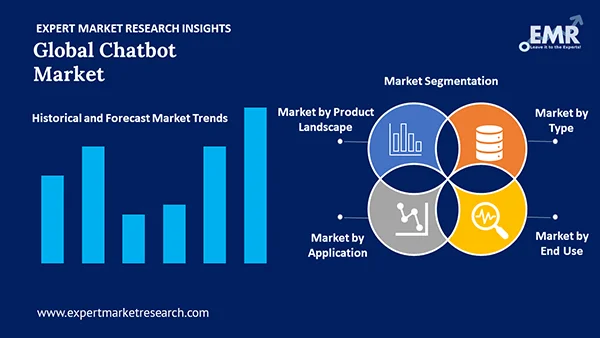
The EMR’s report titled “Chatbot Market Report and Forecast 2026-2035” offers a detailed analysis of the market based on the following segments:
Breakup by Offering
Key Insight: Solutions lead the offering segment in the chatbot market, for driving real business transformation. These include AI-powered customer service bots, lead generation systems, and workflow automation tools that enhance efficiency and reduce costs. In July 2024, Salesforce launched autonomous AI agents that handle customer service tasks for improving efficiency, personalization, and 24/7 support capabilities. The demand for intelligent, scalable solutions is high across banking, retail, healthcare, and e-commerce, making this the most segment prominent due to its direct impact on operational performance and ROI.
Breakup by Type
Key Insight: Web-based chatbot market share is growing with rising integration into websites and web apps for providing instant support and automating tasks, such as answering FAQs, capturing leads, or processing service requests. E-commerce platforms, banks, and service portals rely heavily on web-based bots for seamless customer engagement. In June 2025, the United Kingdom government released a web based chatbot within its new Gov.uk app to answer common queries. The ease of deployment, user accessibility, and integration with CRM tools also makes the segment a go-to choice for businesses to improve customer experience and operational efficiency directly through their online presence.
Breakup by Medium
Key Insight: Contact centers represent a significant segment of the chatbot market, due to wide deployment to handle high volumes of customer queries, automate routine interactions, and reduce call center costs. Several companies use chatbots for initial troubleshooting and routing, enabling human agents to focus on complex issues. In September 2024, Amazon launched an AI assistant for independent sellers, Amelia to provide instant insights on sales metrics, inventory, advertising, and holiday readiness. The ability to operate 24/7 and provide consistent responses makes the segment indispensable for large enterprises aiming to improve customer satisfaction and operational efficiency.
Breakup by Business Function
Key Insight: The sales and marketing segment is contributing to the chatbot market. Businesses widely adopt AI chatbots to generate leads, qualify prospects, run campaigns and provide product recommendations. E-commerce giants use chatbots for personalized shopping experiences, significantly boosting conversions and customer retention. In March 2025, Amazon launched Interests, an AI-powered shopping assistant to track inventory, send alerts and curate personalized selections. These bots initiate proactive conversations, handle customer queries, and integrate with CRM systems to streamline pipelines, emerging essential in industries, especially in B2C environments.
Breakup by Application
Key Insight: Customer services are fostering the chatbot market development to handle millions of queries daily. Companies deploy chatbots to offer 24/7 support for troubleshooting, order tracking, and FAQs. In June 2025, Shipway launched Loca, an AI-powered chatbot to address shipment tracking and delivery delays for D2C brands and e-commerce sellers. These bots improve customer satisfaction by providing instant responses and personalized assistance, significantly lowering wait times. The pandemic accelerated adoption, with brands using chatbots on websites, apps, and social media channels, transforming customer service efficiency across industries worldwide.
Breakup by Vertical
Key Insight: Retail & e-commerce is significantly boosting the chatbot market dynamics with extensive deployment in customer service, product recommendations, and personalized shopping. Brands use AI-driven bots on websites and social platforms to guide users through product selections and address queries instantly. For instance, in June 2024, Yep AI introduced a 24/7 AI Sales Agent on Shopify, enabling automated customer engagement and sales support for online stores. As consumer expectations for real-time assistance grow, especially in mobile commerce, the retail segment remains a strong force in chatbot adoption, boosting conversion rates and enhancing user experience through automation.
Breakup by Region
Key Insight: North America dominates the chatbot market, driven by advanced AI development, high internet penetration, and strong enterprise adoption. According to DataReportal, Canada’s internet penetration hit 94.3% at the start of 2024. Major tech companies lead chatbot innovation, while businesses leverage bots to boost efficiency and customer engagement. Moreover, North America benefits from robust cloud infrastructure and strong investment in AI research, making it the global leader in chatbot deployment and revenue generation across both B2B and B2C sectors.
Rising Demand for Chatbot Services
The services segment of the chatbot market includes chatbot development, system integration, maintenance, and consultation. These are typically offered by third-party providers or internal IT teams. In March 2025, C-DOT collaborated with IIT Delhi to develop an AI-powered chatbot for disaster warnings and emergency response applications across India. While essential for initial setup and ongoing optimization, services follow solution adoption and are more project-based. The segment is further growing with digital transformation initiatives.
Messenger-based/Third Party & Standalone Chatbots to Gain Popularity
Messenger-based/third-party chatbot platforms are recording preference as they are built into messaging apps. Several brands use Messenger bots for flight updates and food ordering. In October 2024, Major United States and European airlines turned to Air India’s expertise to build generative AI chatbots including AI.g, which autonomously handles 97% of queries. These platforms also offer high engagement rates and are especially popular for promotions, reminders, and transactional support.
Standalone chatbot demand is expanding to serve niche or enterprise-specific functions, such as internal employee assistance or specialized services including mental health support and education. While they can be highly customized and secure, adoption is limited due to lower user reach and higher onboarding friction. Users must download or access a separate platform, reducing accessibility and engagement. Despite their potential in specific contexts, standalone bots trail behind web-based and third-party bots in terms of scalability and user penetration.
Websites & Social Media to Drive Chatbots Adoption
Web-based chatbot market share is growing due to their assistance in lead generation, customer support, and personalized product recommendations. Retail giants and service providers employ web chatbots to reduce bounce rates and speed up purchase decisions. The ease of integration with analytics and marketing platforms enhances their effectiveness. Web chatbots help businesses offer instant help, gather customer data, and streamline transactions without requiring additional apps or platforms, making them highly popular across industries.
The demand for social media chatbots is expanding with operations on platforms including Facebook Messenger, WhatsApp, and Instagram. Airlines use Messenger bots for flight bookings and updates, while major brands leverage Instagram bots for product discovery and styling advice. In July 2023, Travelxp partnered with Haptik to launch an Instagram chatbot for travelers to answer destination queries, suggest itineraries, and collects leads via DMs. Benefits of engagement and marketing are also adding to the segment growth.
IT Services & HR Services to Witness Huge Chatbot Penetration
IT service chatbots industry is poised for expansion as it is particularly useful in enterprise tech support and service desk automation. Major firms deploy internal chatbots to improve incident resolution speed and reduce support loads. These bots often integrate with ITSM platforms to route issues, provide updates, and escalate unresolved queries, saving time and reducing human errors. The ability to offer consistent, and scalable support makes them invaluable in maintaining digital infrastructure across large organizations.
Chatbots deployed in HR services help with onboarding, leave applications, benefits inquiries, and policy dissemination. Tools are used to automate common HR tasks and ensure timely communication with employees. These bots improve employee satisfaction by offering instant answers to common questions and facilitating self-service. In July 2025, Rival launched ROSI, a purpose-built conversational AI agent specifically for HR teams and employees. HR chatbots also enhance internal efficiency and user experience, especially in large, distributed teams.
Surging Deployment of Branding & Advertising & Personal Assistance Chatbots
Chatbots in branding and advertising help businesses engage customers with interactive campaigns, product launches, and personalized promotions. Brands like Nike and Coca-Cola use chatbots on social media platforms to deliver targeted ads and gamified experiences. These bots collect user data for tailored marketing while creating memorable brand interactions. These chatbots further play a strategic role in customer acquisition, loyalty, and awareness, driving innovative campaigns that blend conversation with commerce.
Personal assistant chatbot market is driven by the higher need to provide hands-free support for scheduling, reminders, and daily tasks. These bots improve productivity and convenience but primarily serve individual users rather than businesses. Recent advances include integration with third-party apps for shopping or travel planning, enhancing utility. In May 2024, Expedia Group launched Romie, an AI travel assistant that integrates directly with third-party messaging apps like iMessage and WhatsApp. With maturing AI, personal assistants increasingly blend natural language understanding with proactive task management.
Escalating Chabot Presence in BFSI & Media & Entertainment
The BFSI segment is favouring the chatbot industry value for secure transactions, account inquiries, and financial guidance. Banks use bots to provide instant account summaries, credit score updates, and bill payment reminders. In October 2024, Zanaco Bank partnered with JMR Infotech to launch Coco on WhatsApp to offer 24/7 AI-driven customer support and banking services. Insurance companies deploy bots for claim filing and policy advice. With rising demand for digital banking, chatbots further help to reduce operational costs and improve service availability.
Media and entertainment companies leverage chatbots for fan engagement, content recommendations, and ticket booking. For instance, Netflix uses bots for personalized movie suggestions, while music platforms employ bots for user interaction and playlist creation. News outlets use bots to deliver breaking news and summaries through platforms including Facebook Messenger. Gaming companies deploy bots for in-game support and FAQs. The segment shows further promise with growing content consumption.
Thriving Chatbot Industry in Europe & Asia Pacific
Europe chatbot market is driven by digital transformation across finance, public services, and retail sectors. The United Kingdom, Germany, and France are adopting AI bots in government portals and banks for multilingual support and user-friendly interactions. The region emphasizes GDPR compliance, ensuring privacy-conscious bot deployments. Startups and large enterprises are investing in conversational AI to streamline customer service and reduce labour costs. Europe also maintains a steady trajectory in chatbot integration and innovation.
| CAGR 2026-2035 - Market by | Country |
| India | 32.9% |
| China | 27.5% |
| UK | 22.8% |
| USA | 22.2% |
| Germany | 20.5% |
| Canada | XX% |
| France | XX% |
| Italy | XX% |
| Japan | 17.2% |
| Australia | XX% |
| Saudi Arabia | XX% |
| Brazil | XX% |
| Mexico | XX% |
Asia Pacific is the fastest growing chatbot industry due to its vast population and smartphone penetration, especially in India, China, and Indonesia, which is driving higher adoption in e-commerce, fintech, and customer support. In China, companies leverage bots for seamless shopping and banking experiences. The increasing investment in AI and digital services positions Asia Pacific as a key emerging market with significant long-term potential. For instance, in February 2025, China’s tech giant Alibaba pledged USD 53 billion (¥380 billion) over three years to boost AI and cloud infrastructure expansion, driving regional market growth.
Key players operating in the chatbot market are employing several key strategies to drive growth and adoption. One major strategy is AI and NLP integration, enabling chatbots to understand and respond to human language more naturally, improving user experience. Companies also focus on omnichannel deployment, allowing chatbots to function across websites, mobile apps, social media, and messaging platforms, such as WhatsApp and Facebook Messenger. Another strategy is personalization, where chatbots leverage customer data to deliver tailored responses and recommendations.
Conversational commerce is also growing, with chatbots facilitating product discovery, order placement, and payment processing. Businesses often deploy hybrid chatbot models, combining AI with human support for complex queries. Scalability and integration with CRM, ERP, and marketing tools ensure seamless enterprise operations. Furthermore, companies invest in data security and compliance to build user trust, especially in regulated industries. Lastly, analytics and feedback loops help refine chatbot performance over time, enhancing accuracy and engagement. Together, these strategies support a rapidly expanding chatbot ecosystem across industries.
Founded in 2000 and headquartered in San Jose, the United States, [24]7.ai has pioneered intent-driven CX platforms as its Engagement Cloud merges AI-powered agents and human support. The company has won awards like the 2023 Future of Work Agent Experience and multiple industry recognitions for conversational AI.
Launched in Argentina in 2012, Aivo is headquartered in Latin America with global offices and specializes in AI-driven customer service via its “AgentBot” and no-code messaging studio. Aivo supports over 200 clients and more than 300 million interactions and was recently acquired by TalentSync AI.
Founded in 2001, based in Stockholm, Sweden, Artificial Solutions is known for its conversational AI platform, Teneo and has delivered advanced multilingual dialogue systems with NLU and machine learning innovations, serving industries globally. Achievements include leadership standings in enterprise virtual assistant solutions.
Established in 2016 and headquartered in Karachi, Pakistan, Botsify offers an omnichannel chatbot platform with live chat, AI lead capture, and white label options. With over 120,000 users, the firm is recognized for boosting customer engagement and automating support and sales workflows.
*Please note that this is only a partial list; the complete list of key players is available in the full report. Additionally, the list of key players can be customized to better suit your needs.*
Other players in the chatbot market include Creative Virtual Private Limited, Inbenta Technologies Inc., IBM Corporation, eGain Corporation, Acuvate, Next IT Corp., and Nuance Communications, Inc., among others.
Stay ahead with the latest chatbot market trends 2026 and beyond. Download your free sample report from Expert Market Research to explore key growth drivers, regional insights, and emerging technologies shaping the chatbot industry. Make data-backed decisions with expert insights. Don’t miss out—access your sample now!
Mexico chatbot in BFSI Market
Australia Chatbot Market


Upto 15% Off
USD
$2499 $2249
$3999 $3599
$4999 $4249
$5999 $5099


*While we strive to always give you current and accurate information, the numbers depicted on the website are indicative and may differ from the actual numbers in the main report. At Expert Market Research, we aim to bring you the latest insights and trends in the market. Using our analyses and forecasts, stakeholders can understand the market dynamics, navigate challenges, and capitalize on opportunities to make data-driven strategic decisions.*
Get in touch with us for a customized solution tailored to your unique requirements and save upto 35%!
In 2025, the market reached an approximate value of USD 1048.32 Million.
The market is projected to grow at a CAGR of 24.90% between 2026 and 2035.
The key strategies driving the market include AI and NLP advancements, integration with messaging platforms, 24/7 customer service automation, personalized user experiences, and multilingual support. Businesses also focus on omnichannel deployment, cost reduction, lead generation, and customer retention through proactive engagement, while ensuring data privacy and compliance with regional regulations.
The increasing development in artificial intelligence and the rapid technological advancements are the key trends guiding the market growth.
The major regions in the market are North America, Latin America, the Middle East and Africa, Europe, and the Asia Pacific.
The significant types of chatbot are standalone, web based, and messenger based/third party.
Solution, and Services are the various offering of chatbot considered in the market report.
The major applications of the product include Customer Services, Branding & Advertising, Personal Assistance, Data Privacy & Compliance, and Payment Processing, among others.
The different Vertical of chatbot include healthcare, retail, banking financial services and insurance (BFSI), media and entertainment, travel and tourism, and transportation & logistics, among others.
The key players in the market report include [24]7.ai, Inc, Aivo LLC, Artificial Solutions International AB, Botsify Inc., Creative Virtual Private Limited, Inbenta Technologies Inc., IBM Corporation, eGain Corporation, Acuvate, Next IT Corp., and Nuance Communications, Inc., among others.
The market is estimated to witness a healthy growth in the forecast period of 2026-2035 to reach USD 9685.42 Million by 2035.
The retail & e-commerce segment dominated the global chatbot market.
The standalone segment led the global chatbot market.
The customer services segment dominated the global chatbot market.
United Kingdom, Germany, France, and Italy, among others are considered in the European region.
North America is the fastest growing region due to the use of chatbots in sectors like finance and banking.
Fresh mushrooms remain the dominant form in the market due to high consumer preference for minimally processed, nutritious food.
Explore our key highlights of the report and gain a concise overview of key findings, trends, and actionable insights that will empower your strategic decisions.
| REPORT FEATURES | DETAILS |
| Base Year | 2025 |
| Historical Period | 2019-2025 |
| Forecast Period | 2026-2035 |
| Scope of the Report |
Historical and Forecast Trends, Industry Drivers and Constraints, Historical and Forecast Market Analysis by Segment:
|
| Breakup by Offering |
|
| Breakup by Type |
|
| Breakup by Medium |
|
| Breakup by Business Function |
|
| Breakup by Application |
|
| Breakup by Vertical |
|
| Breakup by Region |
|
| Market Dynamics |
|
| Competitive Landscape |
|
| Companies Covered |
|
Datasheet
One User
USD 2,499
USD 2,249
tax inclusive*
Single User License
One User
USD 3,999
USD 3,599
tax inclusive*
Five User License
Five User
USD 4,999
USD 4,249
tax inclusive*
Corporate License
Unlimited Users
USD 5,999
USD 5,099
tax inclusive*
*Please note that the prices mentioned below are starting prices for each bundle type. Kindly contact our team for further details.*
Flash Bundle
Small Business Bundle
Growth Bundle
Enterprise Bundle
*Please note that the prices mentioned below are starting prices for each bundle type. Kindly contact our team for further details.*
Flash Bundle
Number of Reports: 3
20%
tax inclusive*
Small Business Bundle
Number of Reports: 5
25%
tax inclusive*
Growth Bundle
Number of Reports: 8
30%
tax inclusive*
Enterprise Bundle
Number of Reports: 10
35%
tax inclusive*
How To Order

Select License Type
Choose the right license for your needs and access rights.

Click on ‘Buy Now’
Add the report to your cart with one click and proceed to register.

Select Mode of Payment
Choose a payment option for a secure checkout. You will be redirected accordingly.
Gain insights to stay ahead and seize opportunities.

Get insights & trends for a competitive edge.

Track prices with detailed trend reports.

Analyse trade data for supply chain insights.

Leverage cost reports for smart savings

Enhance supply chain with partnerships.

Connect For More Information
Our expert team of analysts will offer full support and resolve any queries regarding the report, before and after the purchase.
Our expert team of analysts will offer full support and resolve any queries regarding the report, before and after the purchase.
We employ meticulous research methods, blending advanced analytics and expert insights to deliver accurate, actionable industry intelligence, staying ahead of competitors.
Our skilled analysts offer unparalleled competitive advantage with detailed insights on current and emerging markets, ensuring your strategic edge.
We offer an in-depth yet simplified presentation of industry insights and analysis to meet your specific requirements effectively.





Share