

Consumer Insights
Uncover trends and behaviors shaping consumer choices today
Procurement Insights
Optimize your sourcing strategy with key market data
Industry Stats
Stay ahead with the latest trends and market analysis.

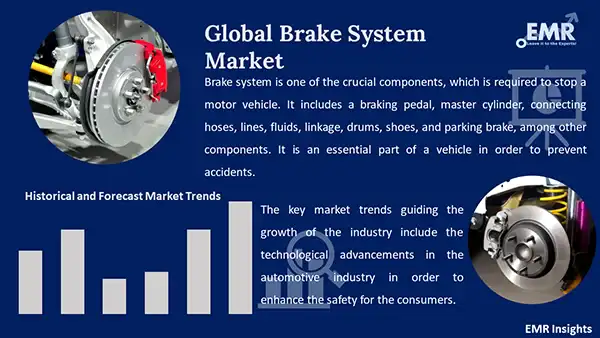
The global brake system market was valued at USD 60.36 Billion in 2025. The industry is expected to grow at a CAGR of 6.40% during the forecast period of 2026-2035 to reach a value of USD 112.24 Billion by 2035. The market growth is attributed to the regulatory momentum mandating Automatic Emergency Braking (AEB) systems across major economies.
In May 2023, the U.S. National Highway Traffic Safety Administration (NHTSA) introduced a landmark rule requiring that all cars and light trucks sold in the country must include AEB by September 2029. Unlike earlier voluntary adoption programs, this regulation imposes stringent requirements such as AEB functioning at highway speeds and the ability to detect pedestrians in low-light conditions.
By significantly raising the performance threshold, the mandate compels automakers and suppliers to accelerate investment in advanced braking technologies, integrating sophisticated sensors, cameras, and intelligent software to meet compliance standards.
This U.S. regulatory milestone is echoed by developments in Asia, where China’s Ministry of Industry and Information Technology (MIIT) announced that beginning January 1, 2028, nearly all new vehicles in the country must be equipped with AEB. As the world’s largest automotive market, China’s regulatory decision carries substantial global weight, ensuring that automakers prioritize AEB integration across mass-market and premium vehicle platforms alike. The alignment of the U.S. and Chinese mandates underscores a broader international shift, creating harmonization that encourages multinational OEMs to develop scalable, standardized braking solutions applicable across diverse markets.
Such regulatory initiatives establish AEB as a non-negotiable baseline for future vehicle safety, while simultaneously driving demand for electronic braking systems, sensor fusion technologies, and software-defined braking architectures. By mandating life-saving features, the U.S. and China are not only enhancing road safety but also accelerating the transformation of the brake system market into a cornerstone of next-generation mobility.
Base Year
Historical Period
Forecast Period
Compound Annual Growth Rate
6.4%
Value in USD Billion
2026-2035
*this image is indicative*
| Global Brake System Market Report Summary | Description | Value |
| Base Year | USD Billion | 2025 |
| Historical Period | USD Billion | 2019-2025 |
| Forecast Period | USD Billion | 2026-2035 |
| Market Size 2025 | USD Billion | 60.36 |
| Market Size 2035 | USD Billion | 112.24 |
| CAGR 2019-2025 | Percentage | XX% |
| CAGR 2026-2035 | Percentage | 6.40% |
| CAGR 2026-2035 - Market by Region | Asia Pacific | 9.1% |
| CAGR 2026-2035 - Market by Country | India | 10.4% |
| CAGR 2026-2035 - Market by Country | China | 8.7% |
| CAGR 2026-2035 - Market by Product Type | Regenerative and Dynamic Brake | 7.9% |
| CAGR 2026-2035 - Market by Distribution Channel | OEM | 7.7% |
| Market Share by Country 2025 | Japan | 3.4% |
The evolution of regenerative braking technologies is accelerating the adoption of advanced brake systems in electric commercial vehicles. A significant example emerged in September 2024, when Accelera by Cummins unveiled its integrated brake chopper resistor (iBCR) at the IAA Transportation event in Hannover, Germany. By combining endurance braking, energy efficiency, and safety, the iBCR helps manage excess braking energy, improves battery optimization, and ensures compliance with UN ECE R 13 standards. This innovation demonstrates how next-generation regenerative braking solutions are driving both regulatory compliance and performance in the global brake system market.
The integration of cybersecurity and over-the-air (OTA) capabilities into braking systems is supporting the global brake system market expansion. As vehicles become increasingly software-defined, braking technologies must ensure digital resilience alongside mechanical reliability. In May 2023, Continental launched its MK 120 ESC with Changan in China, marking the system’s first global production rollout. Featuring encrypted hardware security modules, individual security keys, and OTA support, the system underscores how enhanced security, efficiency, and adaptability are setting new benchmarks for modern braking solutions.
The rapid expansion of electric vehicle production is significantly contributing to the global brake system market growth. As automakers scale EV manufacturing, demand for advanced braking solutions such as regenerative braking, brake-by-wire, and energy-efficient systems is increasing to optimize vehicle range and performance. As per the International Energy Agency, electric car sales exceeded 17 million globally in 2024, highlighting the accelerating adoption of EVs. This trend is prompting companies to invest in lightweight, high-durability components and integrated electronic systems, driving innovation and reinforcing the prominence of EV-focused braking technologies.
Ongoing developments in low emission brakes are emerging as a notable global brake system market trend, as manufacturers increasingly focus on reducing environmental impact while meeting stringent regulatory standards. Innovations in low-emission materials, friction formulations, and energy-efficient manufacturing processes help limit particulate matter and CO₂ output, improving air quality and supporting corporate sustainability goals. A prime example is Tenneco’s Low Emission Brake, launched in April 2025, which leverages renewable and recycled materials to comply with Euro 7 and China 7 standards, showcasing how eco-conscious braking solutions are shaping market growth.
The growing emphasis on advanced braking solutions for rail and transit applications is driving global brake system market demand. As rail networks modernize and expand, brake systems are increasingly required to deliver superior safety, high reliability, and lower maintenance while supporting electrified and zero-emission locomotives. For instance, in April 2025, Wabtec Corporation received a $157 million order from Siemens India for brake systems in the 9000HP locomotive project for Indian Railways. Developed by Wabtec’s India-based team, these systems ensure optimal performance, safety, and durability, highlighting the market’s focus on rail-specific innovations.
Read more about this report - REQUEST FREE SAMPLE COPY IN PDF
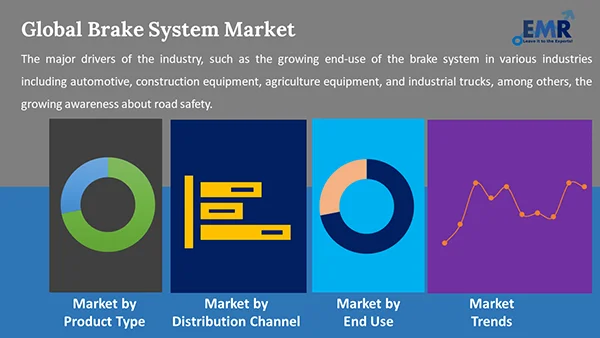
The EMR’s report titled “Global Brake System Market Report and Forecast 2026-2035” offers a detailed analysis of the market based on the following segments:
Market Breakup by Product Type
Key Insight: Disc brakes represent the largest segment in the global brake system market, supported by their superior stopping power, heat management, and widespread use across passenger and commercial vehicles. In contrast, the regenerative and dynamic brake segment is recording the fastest growth, driven by the global shift toward electric and hybrid vehicles where energy recovery is critical for efficiency and extended driving range. While drum, hydrostatic, and hydraulic wet brakes maintain niche demand in specific applications, the market’s momentum is clearly shaped by advanced disc and regenerative braking solutions.
Market Breakup by End Use
Key Insight: Automotive is the largest segment in the global brake system market by end-use, supported by high vehicle production volumes and regulatory mandates for advanced safety systems. Construction equipment demand is driven by global infrastructure development requiring durable braking technologies. Agriculture equipment adoption is supported by mechanization trends in farming and the need for reliable brakes in heavy machinery. Industrial trucks rely on braking systems to improve material handling efficiency and workplace safety. Mining equipment is the fastest growing segment, fueled by rising mineral extraction activities and the need for robust, high-performance braking solutions in extreme conditions.
Market Breakup by Distribution Channel
Key Insight: Original equipment manufacturer (OEM) is the largest segment in the global brake system market by distribution channel, supported by rising vehicle production, integration of advanced safety features at the factory level, and strict regulatory mandates requiring technologies such as ABS, ESC, and AEB. The aftermarket segment, however, is witnessing the fastest growth, driven by the growing vehicle parc, increasing replacement demand for brake pads and rotors, and the rising preference for performance upgrades.
Market Breakup by Region
Key Insight: Asia Pacific is the largest segment in the global brake system market by region, supported by massive automotive production in China, India, and Japan, along with accelerating adoption of electric and hybrid vehicles that demand advanced braking technologies. North America, on the other hand, is the fastest growing segment, fueled by stringent regulatory pushes such as the U.S. mandate for automatic emergency braking by 2029 and rapid integration of electronic and regenerative braking in electric vehicles. Europe maintains steady demand through emission compliance and automation trends, while Latin America and the Middle East and Africa expand at a gradual pace.
Read more about this report - REQUEST FREE SAMPLE COPY IN PDF
By product type, disc brake accounts for the largest share
The disc brake segment is primarily driven by the need to enhance vehicle performance through weight reduction, superior heat management, and reliable stopping power. Lighter brake components improve acceleration, fuel efficiency, and overall drivability, making weight optimization a critical focus for OEMs. In December 2024, Orbis Brakes Inc. licensed a NASA-patented technology to create disc rotors at least 42% lighter than conventional cast iron designs while maintaining high performance. By combining material innovation with engineering precision, manufacturers continue to advance disc brake technology, reinforcing its dominance across passenger and commercial vehicles globally.
The regenerative and dynamic brakes is the fastest growing in the global brake system market, attributed to the global shift toward electric and hybrid vehicles, where energy recovery is essential for efficiency and extended driving range. These braking systems capture kinetic energy during deceleration and convert it into electrical energy, improving overall vehicle efficiency and reducing dependency on traditional friction brakes. As automakers increasingly focus on sustainability and EV performance, the demand for regenerative and dynamic braking technologies will continue to rise.
By end-use, represents the biggest portion of the market
Automotive end-use accounts for the largest revenue share of the global brake system market owing to the rapid adoption of electric and hybrid vehicles. EVs and hybrids require advanced braking technologies, such as regenerative braking and brake-by-wire systems, to optimize energy recovery, extend driving range, and enhance overall efficiency. Automakers are increasingly integrating these solutions into new vehicle models while ensuring performance and safety standards are met, thereby fueling brake systems demand in automotive manufacturing.
Besides this, the need for robust braking solutions capable of withstanding extreme operational conditions is driving demand from mining equipment. Mining machinery operates under heavy loads in harsh environments, requiring high-durability, heat-resistant braking systems to ensure safety and operational efficiency. Advanced hydraulic, wet, and dynamic brakes are increasingly adopted to provide reliable stopping power, minimize downtime, and maintain performance, further fueling demand.
By distribution channel, OEMs generate the highest revenue
OEMs lead the global brake system market due to the integration of advanced safety features at the factory level. Automakers are increasingly equipping vehicles with systems such as ABS, ESC, and AEB to comply with stringent safety regulations and enhance overall driving performance. By installing high-quality braking components during production, OEMs ensure consistent reliability and efficiency, supporting regulatory compliance and consumer trust. This focus on factory-fitted, technologically advanced solutions reinforces OEMs as the largest distribution channel segment globally.
On the other hand, the rising preference for performance upgrades is boosting the aftermarket growth. Vehicle owners are investing in high-performance brake pads, rotors, and advanced components to improve braking efficiency, handling, and safety. As the vehicle parc grows, replacement demand rises, further fueling aftermarket expansion. The combination of performance-focused upgrades and maintenance requirements makes the aftermarket the fastest-growing distribution channel in the global brake system market.
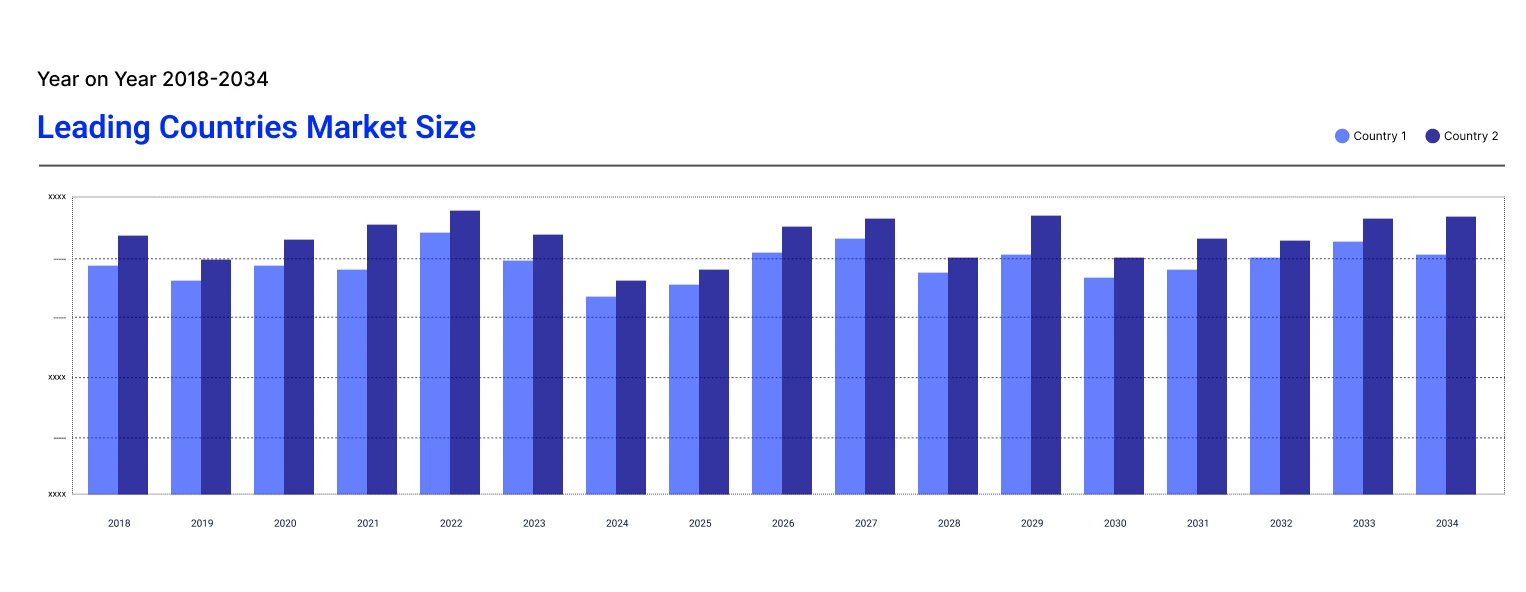
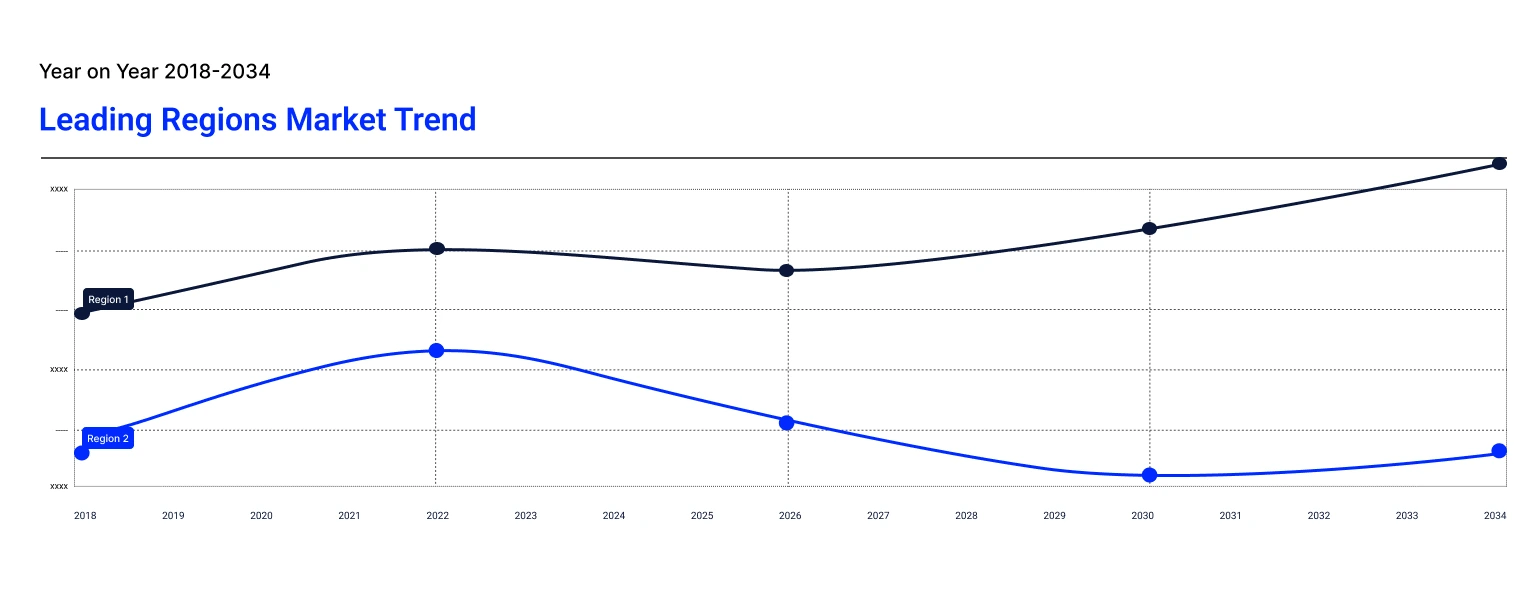
By region, Asia Pacific leads the market growth
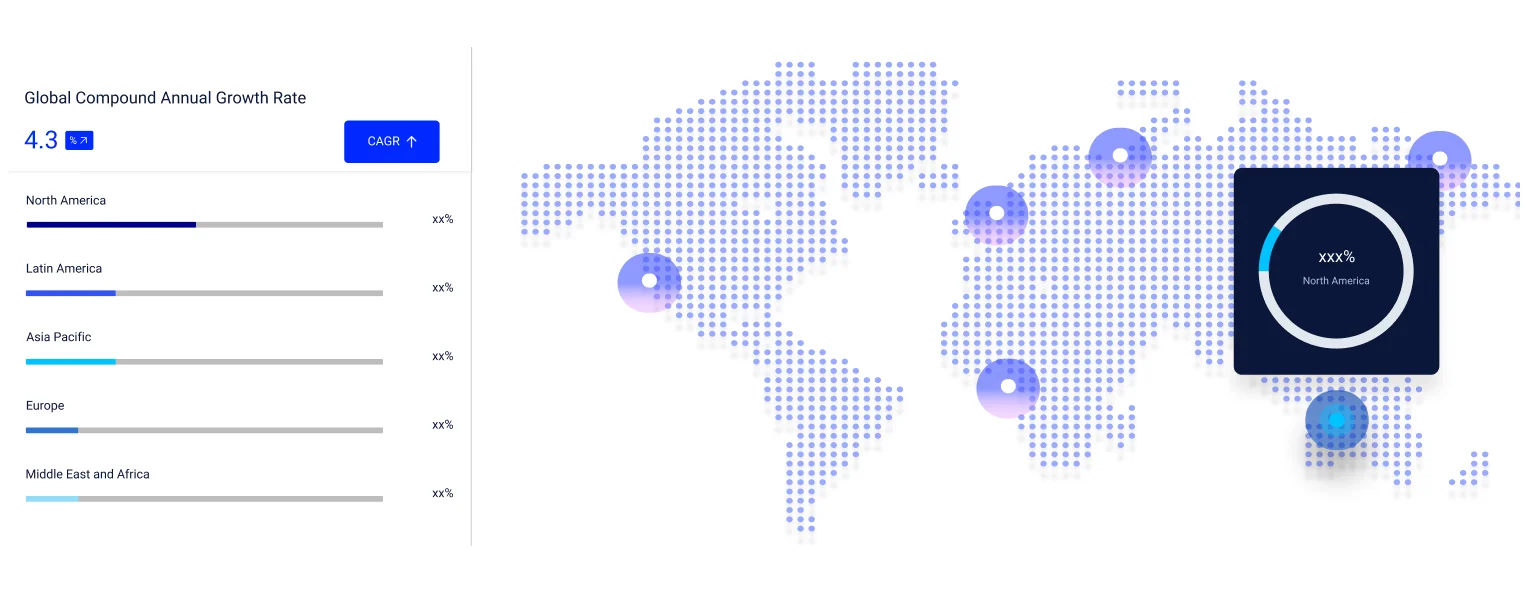
Asia Pacific dominates the global brake system market, driven by stringent safety regulations and rapid adoption of advanced braking technologies. In Japan, all new passenger cars have been required to include automatic emergency braking (AEB) since fiscal year 2021. Similarly, key economies like India and China are taking such proactive initiatives, which are pushing OEMs and suppliers to implement electronic, regenerative, and brake-by-wire systems. By aligning with these regional regulatory standards, companies are accelerating innovations in braking systems.
Meanwhile, North America is witnessing the fastest growth rate due to the strong presence of leading OEMs and Tier-1 suppliers. Companies such as Ford, GM, Tesla, and Bosch are investing heavily in regional innovation and testing, focusing on advanced technologies like regenerative braking, brake-by-wire, and electronic stability control. By leveraging robust R&D capabilities and local production infrastructure, these players are accelerating the adoption of high-performance, efficient, and safety-focused braking solutions, thereby propelling regional industry growth.
| CAGR 2026-2035 - Market by | Country |
| India | 10.4% |
| China | 8.7% |
| Canada | 6.6% |
| Mexico | 6.5% |
| Australia | 6.2% |
| USA | XX% |
| UK | XX% |
| Germany | 5.1% |
| France | XX% |
| Japan | XX% |
| Saudi Arabia | XX% |
| Brazil | XX% |
| Italy | 4.4% |
Major brake system companies are intensifying efforts to expand their technological capabilities and strengthen competitive positioning. Companies such as Continental AG, Brembo, and Aisin Seiki are investing heavily in research and development to introduce advanced braking solutions, including electronic stability control, brake-by-wire, and regenerative braking systems. These strategies focus on enhancing safety, efficiency, and performance while aligning with regulatory mandates across key markets. Partnerships with OEMs and collaborative innovation projects further enable global brake system market players to achieve scalability and market penetration.
To maintain a competitive edge, leading brake system companies are also emphasizing sustainability and electrification strategies. BorgWarner, Hitachi Astemo, and Knorr-Bremse are developing solutions tailored for electric and hybrid vehicles, integrating energy recovery, lightweight materials, and modular designs. In addition, players are adopting digitalization approaches such as over-the-air software updates, predictive maintenance analytics, and connected braking systems. By combining technological innovation with strategic partnerships, these companies aim to meet evolving consumer expectations and drive long-term growth in the increasingly complex automotive ecosystem, thereby boosting global brake system market growth.
Established in 1949, Aisin Seiki of Kariya, Japan, is a leading global supplier of automotive components, specializing in brake systems, drivetrains, and safety technologies. Its engineering innovations continue to support major OEMs worldwide.
Renowned for high-performance braking systems across passenger vehicles, motorcycles, and motorsports, Brembo was founded in 1961 in Curno, Italy. The company is recognized globally for combining advanced design with precision engineering.
With origins dating back to 1871 in Hanover, Germany, Continental AG is a global automotive technology leader offering advanced brake systems, safety solutions, and mobility innovations. Its expertise in electronic stability and driver assistance underscores its influence in modern vehicle safety.
A prominent provider of braking and powertrain solutions, BorgWarner was founded in 1928 in Auburn Hills, Michigan, USA. The company is increasingly focused on electrification and sustainable mobility, delivering innovative solutions for conventional and electric vehicles alike.
*Please note that this is only a partial list; the complete list of key players is available in the full report. Additionally, the list of key players can be customized to better suit your needs.*
Other players in the Global Brake System Market include Hitachi Astemo, Ltd., Knorr-Bremse AG, Nissin Kogyo Co., Ltd., among others.
Explore the latest trends shaping the Global Brake System Market 2026-2035 with our in-depth report. Gain strategic insights, future forecasts, and key market developments that can help you stay competitive. Get your free sample report or contact our team for customized consultation on global brake system market trends 2026.
North America Brake System Market
Automotive Air Brake System Market


Upto 15% Off
USD
$2499 $2249
$3999 $3599
$4999 $4249
$5999 $5099


*While we strive to always give you current and accurate information, the numbers depicted on the website are indicative and may differ from the actual numbers in the main report. At Expert Market Research, we aim to bring you the latest insights and trends in the market. Using our analyses and forecasts, stakeholders can understand the market dynamics, navigate challenges, and capitalize on opportunities to make data-driven strategic decisions.*
Get in touch with us for a customized solution tailored to your unique requirements and save upto 35%!
The market is projected to grow at a CAGR of 6.40% between 2026 and 2035.
The market is estimated to witness a healthy growth in the forecast period of 2026-2035 to reach USD 112.24 Billion by 2035.
Key strategies driving the market include investing in advanced braking technologies such as brake-by-wire, regenerative braking, and electronic stability control, forming strategic partnerships with OEMs, adopting lightweight and energy-efficient components, and integrating cybersecurity and over-the-air update capabilities to meet regulatory and technological demands.
The key trends guiding the growth of the market include the technological advancements in the automotive industry in order to enhance the safety for the consumers and the growing mechanisations in downstream industries.
The major regions in the market are North America, Latin America, the Middle East and Africa, Europe, and the Asia Pacific.
Disc brake, drum brake, hydrostatic brake, hydraulic wet brake, and regenerative and dynamic brake are the various product types in the market.
Automotive, construction equipment, agriculture equipment, industrial truck, and mining equipment are the leading end uses of braking system in the market.
Original equipment manufacturer (OEM) and aftermarket are the significant distribution channels of braking system in the market.
The key players in the market include Aisin Seiki Co., Ltd., Brembo S.p.A., Continental AG, BorgWarner Inc., Hitachi Astemo, Ltd., Knorr-Bremse AG, Nissin Kogyo Co., Ltd., and others.
In 2025, the global brake system market reached an approximate value of USD 60.36 Billion.
Asia Pacific holds the largest share, driven by high automotive production in China, India, and Japan and the rapid adoption of electric and hybrid vehicles requiring advanced braking technologies.
Explore our key highlights of the report and gain a concise overview of key findings, trends, and actionable insights that will empower your strategic decisions.
| REPORT FEATURES | DETAILS |
| Base Year | 2025 |
| Historical Period | 2019-2025 |
| Forecast Period | 2026-2035 |
| Scope of the Report |
Historical and Forecast Trends, Industry Drivers and Constraints, Historical and Forecast Market Analysis by Segment:
|
| Breakup by Product Type |
|
| Breakup by End Use |
|
| Breakup by Distribution Channel |
|
| Breakup by Region |
|
| Market Dynamics |
|
| Competitive Landscape |
|
| Companies Covered |
|
| Report Price and Purchase Option | Explore our purchase options that are best suited to your resources and industry needs. |
| Delivery Format | Delivered as an attached PDF and Excel through email, with an option of receiving an editable PPT, according to the purchase option. |
Datasheet
One User
USD 2,499
USD 2,249
tax inclusive*
Single User License
One User
USD 3,999
USD 3,599
tax inclusive*
Five User License
Five User
USD 4,999
USD 4,249
tax inclusive*
Corporate License
Unlimited Users
USD 5,999
USD 5,099
tax inclusive*
*Please note that the prices mentioned below are starting prices for each bundle type. Kindly contact our team for further details.*
Flash Bundle
Small Business Bundle
Growth Bundle
Enterprise Bundle
*Please note that the prices mentioned below are starting prices for each bundle type. Kindly contact our team for further details.*
Flash Bundle
Number of Reports: 3
20%
tax inclusive*
Small Business Bundle
Number of Reports: 5
25%
tax inclusive*
Growth Bundle
Number of Reports: 8
30%
tax inclusive*
Enterprise Bundle
Number of Reports: 10
35%
tax inclusive*
How To Order

Select License Type
Choose the right license for your needs and access rights.

Click on ‘Buy Now’
Add the report to your cart with one click and proceed to register.

Select Mode of Payment
Choose a payment option for a secure checkout. You will be redirected accordingly.
Gain insights to stay ahead and seize opportunities.

Get insights & trends for a competitive edge.

Track prices with detailed trend reports.

Analyse trade data for supply chain insights.

Leverage cost reports for smart savings

Enhance supply chain with partnerships.

Connect For More Information
Our expert team of analysts will offer full support and resolve any queries regarding the report, before and after the purchase.
Our expert team of analysts will offer full support and resolve any queries regarding the report, before and after the purchase.
We employ meticulous research methods, blending advanced analytics and expert insights to deliver accurate, actionable industry intelligence, staying ahead of competitors.
Our skilled analysts offer unparalleled competitive advantage with detailed insights on current and emerging markets, ensuring your strategic edge.
We offer an in-depth yet simplified presentation of industry insights and analysis to meet your specific requirements effectively.





Share