

Consumer Insights
Uncover trends and behaviors shaping consumer choices today
Procurement Insights
Optimize your sourcing strategy with key market data
Industry Stats
Stay ahead with the latest trends and market analysis.

The Australia railroads market was valued at USD 41.26 Billion in 2025. The industry is expected to grow at a CAGR of 6.80% during the forecast period of 2026-2035 to reach a value of USD 79.66 Billion by 2035.
The Australia railroads market is currently undergoing a high-tech transformation, powered by digital signalling upgrades, intermodal automation, and green hydrogen corridors. The market is deeply intertwined with the nation’s infrastructure goals. The Australian Government's 10-year National Freight and Supply Chain Strategy, initiated in 2019, is driving large-scale rail investments. USD 14.5 billion has been allocated for Inland Rail between Melbourne to Brisbane. Moreover, the Australian Rail Track Corporation (ARTC) is pushing predictive maintenance systems and remote condition monitoring to reduce network downtime and ensure higher asset utilisation.
Demand for smarter and greener transport is fuelling innovation in the Australia railroads market. For example, the New South Wales (NSW) Government launched its Rail Service Improvement Programme which includes trialling hydrogen-powered passenger trains, placing Australia on the path of decarbonising rail mobility. The Victorian Government, on the other hand, is rolling out driverless freight systems on select freight corridors to speed up turnaround times. These shifts are part of broader strategy to turn Australia into an integrated, multimodal freight-and-passenger hub.
B2B stakeholders in sectors such as rolling stock manufacturing, rail electrification, predictive software, and logistics services are finding niche opportunities to build tailored solutions, boosting the Australia railroads market development.
Base Year
Historical Period
Forecast Period
Compound Annual Growth Rate
6.8%
Value in USD Billion
2026-2035
*this image is indicative*
The Australia railroads market dynamics is being boosted by the advent of rail propulsion through hydrogen. The NSW Government commissioned trials of hydrogen-powered passenger trains under its Fast Rail initiative. These trains emit low levels of CO2 and use onboard fuel cells to generate electricity, aligning with Australia’s 2050 Net Zero goal. Companies like Alstom and CAF are localising hydrogen systems to suit regional tracks. The ARTC is also exploring hybrid hydrogen-electric models for freight corridors. Hydrogen rail represents a clean mobility option. These innovations are stimulating new partnerships between energy startups and rail OEMs across Australia.
Rail operators in Australia are investing in predictive analytics for rolling stock and track infrastructure. ARTC, for instance, has embedded IoT sensors and digital twins into major freight lines, enabling early fault detection. Queensland Rail is collaborating with startups to trial AI systems that analyse wheel stress, rail wear, and passenger load in real time. These tools have reduced unplanned downtime by a significant extent. AI-powered maintenance not only boosts reliability but also lowers costs for B2B service vendors.
Freight corridors across Australia are being redesigned with automation as a central component, incorporating AI-driven cargo handling, robotic systems, and real-time tracking to boost efficiency and minimise manual intervention. For example, UGL Rail is integrating smart gantry systems and adaptive routing algorithms at key terminals. These systems reduce idle time and human error, accelerating the Australia railroads market value. Meanwhile, the Federal Government’s National Intermodal Corporation is supporting AI-led control centres for hub coordination.
The Australia railroads market growth is further accelerated by the advent of driverless trains. In 2024, Hitachi Rail deployed fully autonomous freight trains along low-traffic mining routes, integrating lidar, onboard decision systems, and remote override protocols, by partnering with Rio Tinto. These innovations are accompanied by legal sandboxing initiatives to regulate autonomy. For global rail technology companies, Australia offers a relatively open regulatory experimentation hub for launching safety-first automation solutions.
The Australia railroads market is embracing collaborative innovation. The iMOVE Cooperative Research Centre, funded by the Australian Government, is backing cross-sector rail R&D from universities, AI labs, and civil contractors. In South Australia, the Tonsley Innovation District has become home to digital rail simulators and next-gen signalling prototypes. These hubs bring together mining firms, defence contractors, and mobility startups under one roof. Such innovation hubs are becoming instrumental for testing and deploying dual-use rail technologies, from remote operations for mining to smart ticketing for metro cities.
Read more about this report - REQUEST FREE SAMPLE COPY IN PDF
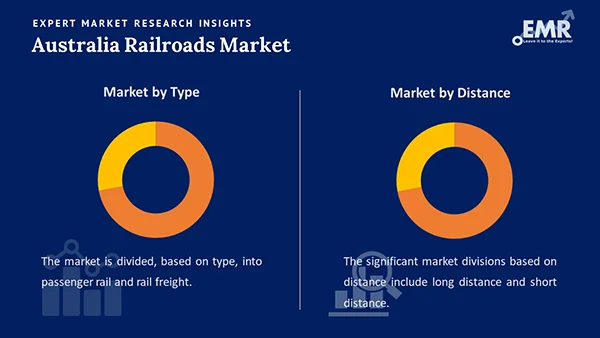
The EMR’s report titled “Australia Railroads Market Report and Forecast 2026-2035” offers a detailed analysis of the market based on the following segments:
Market Breakup by Type
Key Insight: Australia’s railroads market is segmented into passenger and freight services, each propelled by distinct drivers. Passenger rail is benefitting from smart city programmes and increased urban mobility demand, with governments focused on hydrogen-powered trains and AI-driven operations. Freight rail is witnessing faster growth due to Inland Rail, digital logistics upgrades, and automation integration. While passenger systems prioritise commuter experience and environmental targets, freight operations are more focused on efficiency.
Market Breakup by Distance
Key Insight: Australian rail operations are spread across long-distance and short-distance segments, shaped by different regional and urban requirements. Long-distance services play a crucial role in interstate freight and cross-country travel, driven by upgrades in fuel systems and passenger experience. On the other hand, short-distance rail is becoming more vital within metro cities and urban belts, with a focus on speed, frequency, and seamless ticketing.
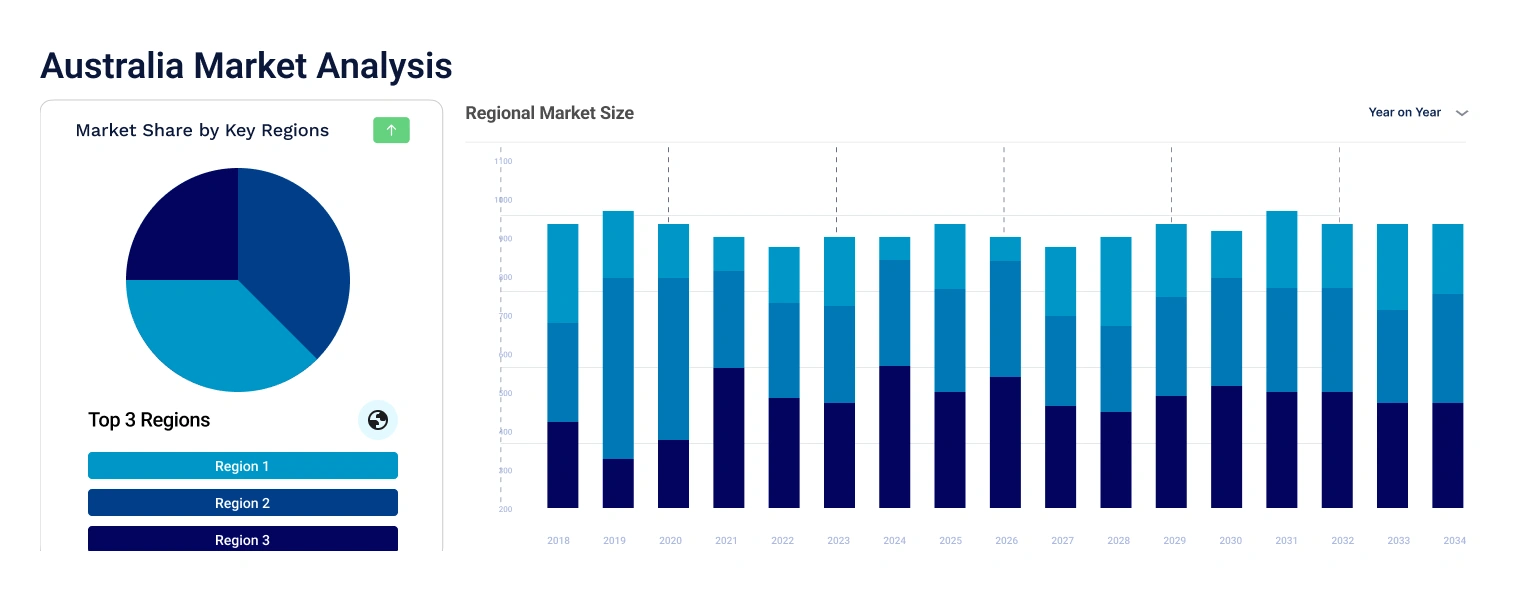
Market Breakup by Region
Key Insight: Regional growth in the Australia railroad industry is led by New South Wales (NSW) and Victoria, both investing in urban rail modernisation and intermodal freight. NSW stands out for scale, with extensive metro projects and hydrogen rail trials, while Victoria is noted for speed and tech-led innovation, especially in suburban and airport rail links. Other regions like Queensland and Western Australia are growing due to major investments made for resource transport. However, NSW and Victoria provide the most comprehensive and commercially engaging landscapes for vendors and rail technology developers looking to embed their solutions in both public and private ecosystems.
By Type, Passenger Rail Accounts for the Largest Share of the Market
Passenger rail remains dominant in the Australia railroads market, supported by rising urbanisation and public transport investments. Sydney Trains, Metro Trains Melbourne, and TransPerth are expanding routes with improved service frequency. The Sydney Metro expansion project currently has 46 stations and has introduced the second driverless train line with ongoing innovation. Green mobility drives are also pushing electric multiple units (EMUs) and trial hydrogen rail. From airport rail links to suburban extensions, passenger rail projects are focused on intermodality and faster last-mile integration.
Rail freight is the fastest growing subsegment as considered in the Australia railroads market report, driven by the Inland Rail mega project and growing intermodal logistics. Freight volumes are growing due to rising exports of minerals, agricultural goods, and consumer products. Private operators are shifting from road freight to rail freight to reduce carbon emissions and reduce costs. Automated loading, condition-based maintenance, and digital route optimisation are further transforming freight handling.
By Distance, the Long-Distance Segment Boasts Higher Market Share
Long-distance rail holds dominance in the Australia railroads market owing to the region’s expansive geography and strong demand for inter-state cargo and tourism. Major freight corridors like Melbourne-Brisbane and Sydney-Perth have become the backbone of domestic trade. Passenger services like the Indian Pacific and The Ghan are also receiving upgrades under regional tourism infrastructure funding. The rollout of hybrid powertrains and predictive maintenance on these routes ensures minimal breakdowns and energy efficiency. Operators are investing in improved onboard experiences, including business-class cabins and smart ticketing platforms, for long-haul travel.
Short-distance rail is gaining major traction in the Australia railroads market due to suburban rail extensions and city transit expansions. Projects like METRONET in Perth and Suburban Rail Loop in Melbourne are enabling high-frequency short trips with reduced dwell times. These projects integrate fare capping technology and mobility-as-a-service (MaaS) platforms. The Victorian Government is trialling contactless biometric ticketing, allowing frictionless entry and faster turnaround. Such innovations are driving ridership and making suburban rail more attractive than cars.
By Region, New South Wales Registers the Dominant Position in the Market
New South Wales leads the railroads market in Australia with transformative projects like Sydney Metro and regional fast rail upgrades. The state government has committed USD 28 billion to urban and regional rail since 2020. The region is also testing hydrogen-powered rail infrastructure and AI-powered scheduling to reduce delays. Sydney Trains has installed AI-based video analytics to optimise security and carriage capacity during peak hours. Freight corridors connecting Port Botany to Western NSW are being digitally upgraded for 24/7 operations.
The Victoria railroads market is emerging as the fastest-growing regional industry with flagship projects like the Suburban Rail Loop and Melbourne Airport Rail. These are being designed as fully electrified, AI-managed corridors with multimodal interchange points. Victoria is also leading in regional freight upgrades, linking agribusiness zones to ports with double-stacked rail and autonomous cargo systems. The regional market's strategic focus on innovation and intermodality is drawing attention from global and local B2B solution providers alike.
The Australia railroad market players are focusing on key areas such as predictive analytics, autonomous driving technology, and sustainable rolling stock. With strong public investments and regulatory clarity, the market offers openings in next-gen signalling, embedded AI, and modular railcar systems.
Private Australia railroads companies are forming consortiums with local governments to de-risk pilot projects and fast-track deployments. International OEMs are localising production to meet state-specific compliance, while startups are testing AI software in live networks. The B2B ecosystem is maturing quickly, with growing demand for interoperable platforms and technology that enables real-time coordination between freight, metro, and regional rail systems. In addition, increasing focus is placed on edge computing, cyber-resilient control architectures, and retrofitting legacy fleets with green traction systems.
Bombardier Transportation, established in 1974 and headquartered in Berlin, Germany, plays a key role in supplying electric multiple units and smart control systems across Australian urban and regional lines. The company collaborates with local firms to tailor signalling platforms, focusing on speed management, safety automation, and real-time diagnostics. Bombardier has also contributed to projects like Sydney Metro by integrating energy-efficient drive systems and embedded analytics.
Downer Group, founded in 1933 and headquartered in Sydney, Australia, is a major player in rail design, construction, and rolling stock services. The company provides comprehensive rail asset management, refurbishments, and digital upgrades. It has led maintenance contracts for Queensland Rail and supplied high-capacity trains to Victoria. Downer’s growing focus is on hybridisation and remote diagnostics.
UGL Rail, a division of UGL Limited established in 1899, focuses on end-to-end rail solutions including rolling stock engineering, automation, and signalling. The company partners with government agencies to deliver high-efficiency locomotives, energy control modules, and software-defined train operations.
Alstom SA, founded in 1928 and headquartered in Saint-Ouen, France, is active in the Australian market through localised delivery of light rail vehicles, signalling systems, and hydrogen-ready trains. The company supported the launch of Adelaide’s tram fleet and contributes to the Sydney Metro project with CBTC (communications-based train control) technology. Alstom also partners with research institutes to advance smart energy storage and sustainable rail propulsion in regional projects.
*Please note that this is only a partial list; the complete list of key players is available in the full report. Additionally, the list of key players can be customized to better suit your needs.*
Explore the latest trends shaping the Australia Railroads Market 2026-2035 with our in-depth report. Gain strategic insights, future forecasts, and key market developments that can help you stay competitive. Download a free sample report or contact our team for customized consultation on Australia Railroads Market trends 2026.


Upto 15% Off
USD
$2499 $2249
$3999 $3599
$4999 $4249
$5999 $5099


*While we strive to always give you current and accurate information, the numbers depicted on the website are indicative and may differ from the actual numbers in the main report. At Expert Market Research, we aim to bring you the latest insights and trends in the market. Using our analyses and forecasts, stakeholders can understand the market dynamics, navigate challenges, and capitalize on opportunities to make data-driven strategic decisions.*
Get in touch with us for a customized solution tailored to your unique requirements and save upto 35%!
In 2025, the Australia railroads market reached an approximate value of USD 41.26 Billion.
The market is projected to grow at a CAGR of 6.80% between 2026 and 2035.
The market is estimated to witness a healthy growth in the forecast period of 2026-2035 to reach a value of USD 79.66 Billion by 2035.
Key strategies driving the market include leveraging public-private partnerships, co-developing AI tools, localising hydrogen rail platforms, investing in automation pilots, and aligning solutions with Australia’s decarbonisation and supply chain resilience policies.
Hydrogen trains, predictive maintenance, autonomous rail, AI-led freight, and cross-sector innovation hubs are some of the key trends reshaping the market.
The major regions in the industry are New South Wales, Victoria, Queensland, Western Australia, South Australia, and others.
The significant types include passenger rail and rail freight.
The significant market divisions based on distance include long distance and short distance.
The major players in the industry are Bombardier Transportation, Downer Group, UGL Rail, Alstom SA, and others.
The key challenges are fragmented infrastructure funding, varying state-level standards, and skills shortages in digital and electrification roles, delaying project timelines and increasing lifecycle management costs for vendors.
Explore our key highlights of the report and gain a concise overview of key findings, trends, and actionable insights that will empower your strategic decisions.
| REPORT FEATURES | DETAILS |
| Base Year | 2025 |
| Historical Period | 2019-2025 |
| Forecast Period | 2026-2035 |
| Scope of the Report |
Historical and Forecast Trends, Industry Drivers and Constraints, Historical and Forecast Market Analysis by Segment:
|
| Breakup by Type |
|
| Breakup by Distance |
|
| Breakup by Region |
|
| Market Dynamics |
|
| Competitive Landscape |
|
| Companies Covered |
|
| Report Price and Purchase Option | Explore our purchase options that are best suited to your resources and industry needs. |
| Delivery Format | Delivered as an attached PDF and Excel through email, with an option of receiving an editable PPT, according to the purchase option. |
Datasheet
One User
USD 2,499
USD 2,249
tax inclusive*
Single User License
One User
USD 3,999
USD 3,599
tax inclusive*
Five User License
Five User
USD 4,999
USD 4,249
tax inclusive*
Corporate License
Unlimited Users
USD 5,999
USD 5,099
tax inclusive*
*Please note that the prices mentioned below are starting prices for each bundle type. Kindly contact our team for further details.*
Flash Bundle
Small Business Bundle
Growth Bundle
Enterprise Bundle
*Please note that the prices mentioned below are starting prices for each bundle type. Kindly contact our team for further details.*
Flash Bundle
Number of Reports: 3
20%
tax inclusive*
Small Business Bundle
Number of Reports: 5
25%
tax inclusive*
Growth Bundle
Number of Reports: 8
30%
tax inclusive*
Enterprise Bundle
Number of Reports: 10
35%
tax inclusive*
How To Order

Select License Type
Choose the right license for your needs and access rights.

Click on ‘Buy Now’
Add the report to your cart with one click and proceed to register.

Select Mode of Payment
Choose a payment option for a secure checkout. You will be redirected accordingly.
Gain insights to stay ahead and seize opportunities.

Get insights & trends for a competitive edge.

Track prices with detailed trend reports.

Analyse trade data for supply chain insights.

Leverage cost reports for smart savings

Enhance supply chain with partnerships.

Connect For More Information
Our expert team of analysts will offer full support and resolve any queries regarding the report, before and after the purchase.
Our expert team of analysts will offer full support and resolve any queries regarding the report, before and after the purchase.
We employ meticulous research methods, blending advanced analytics and expert insights to deliver accurate, actionable industry intelligence, staying ahead of competitors.
Our skilled analysts offer unparalleled competitive advantage with detailed insights on current and emerging markets, ensuring your strategic edge.
We offer an in-depth yet simplified presentation of industry insights and analysis to meet your specific requirements effectively.





Share